

How to Optimize Your Website for AI Search and AI-Powered Search Engines
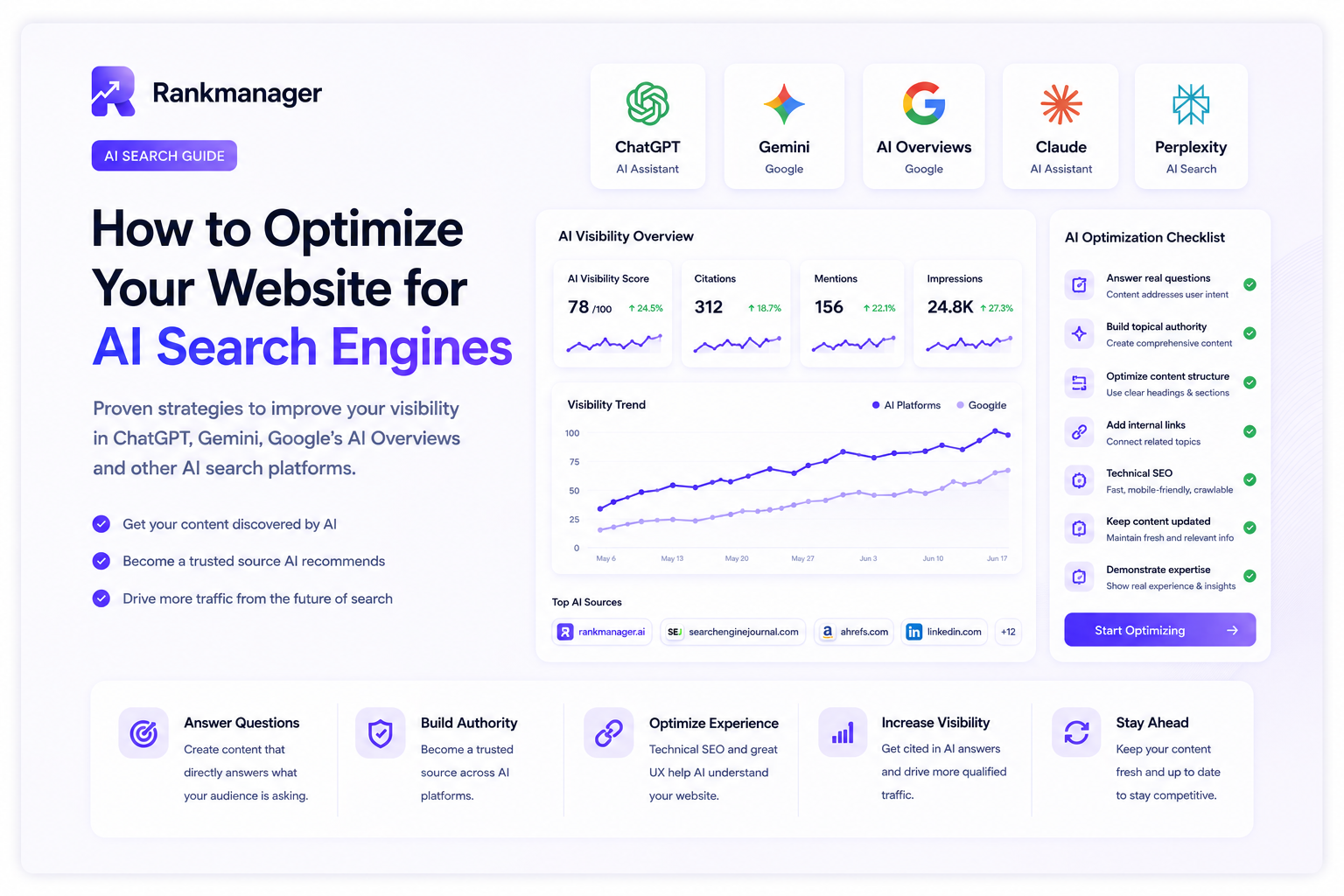
How to Optimize Your Website for AI Search Engines
Introduction
Search is entering a new era.
People are no longer relying solely on Google to find information. Instead, millions of users are asking AI-powered platforms like ChatGPT, Google AI Overviews, Gemini, Claude, and Perplexity for recommendations, answers, and buying advice.
This shift changes how websites should be optimized.
Traditional SEO is still essential, but if you want your business to remain visible over the coming years, you also need to optimize for AI-powered search.
In this guide, you’ll learn exactly how to optimize your website for AI Search and increase your chances of being cited, recommended, and discovered by AI systems.
What Is AI Search Optimization?
AI Search Optimization is the process of making your website easier for AI systems to understand, trust, and recommend.
Instead of focusing only on search rankings, you’re optimizing your website so AI assistants can confidently use your content when answering users’ questions.
This approach is often referred to as Generative Engine Optimization (GEO).
Unlike traditional SEO, success isn’t measured only by rankings—it also includes visibility within AI-generated answers.
Why AI Search Matters
Consumer behavior is changing rapidly.
Instead of searching:
“Best project management software”
People now ask:
“What is the best project management software for a remote marketing team?”
Instead of reading ten articles, they receive one comprehensive answer generated by AI.
If your website isn’t part of that answer, you’re invisible.
The good news?
Most businesses haven’t optimized for AI Search yet, creating a significant opportunity for early adopters.Step 1: Build a Strong SEO Foundation
AI Search doesn’t replace SEO.
It builds on it.
Before focusing on AI optimization, make sure your website follows SEO best practices.
Your website should have:
- Fast loading pages
- HTTPS security
- Mobile-friendly design
- Clean URL structure
- Proper indexing
- XML sitemaps
- Internal linking
- High-quality content
AI platforms trust websites that search engines already consider reliable.
Step 2: Create Helpful, In-Depth Content
One of the biggest differences between traditional SEO and AI Search is content quality.
AI prefers content that completely answers a question.
Instead of writing short articles targeting one keyword, create comprehensive resources.
A strong article should include:
- Clear definitions
- Practical examples
- Step-by-step instructions
- Frequently asked questions
- Common mistakes
- Actionable advice
The goal is to become the best available answer—not simply another article.
Step 3: Organize Content into Topic Clusters
AI systems don’t evaluate pages individually.
They evaluate expertise.
That’s why topic clusters have become increasingly important.
For example, instead of publishing unrelated articles, create a structured knowledge hub.
AI Search
- What Is AI Search?
- SEO vs GEO
- How to Rank in ChatGPT
- AI Search Ranking Factors
- AI SEO Checklist
- AI Visibility Explained
- Common AI Search Mistakes
This tells AI that your website specializes in AI Search rather than occasionally writing about it.
Step 4: Answer Questions Immediately
AI platforms value content that gets to the point.
Every article should answer its primary question within the first few paragraphs.
For example:
What is AI Search?
AI Search uses artificial intelligence to understand user intent and generate complete answers instead of displaying a list of webpages.
After providing a concise answer, expand into greater detail.
This structure improves readability and increases the likelihood of being referenced by AI.
Step 5: Write for Humans, Not Algorithms
Old SEO tactics are becoming less effective.
Avoid:
- Keyword stuffing
- Awkward wording
- Repetitive headings
- Artificial keyword density
Instead, write naturally.
Imagine you’re explaining a topic to a customer sitting across the table.
If your content is easy for people to understand, it’s usually easier for AI to understand as well.
Step 6: Build Topical Authority
Publishing one article about a subject isn’t enough.
AI systems look for consistent expertise.
The more high-quality content you publish around one topic, the more authority your website develops.
Rather than covering dozens of unrelated subjects, focus on becoming the expert in your niche.
Depth beats breadth.
Step 7: Improve Internal Linking
Internal links help AI understand relationships between your content.
For example, an article about AI Search should naturally link to:
- SEO vs GEO
- AI SEO Checklist
- AI Visibility
- Technical SEO
- WordPress SEO
- AI Content Strategy
Likewise, those articles should link back.
This creates a strong knowledge network across your website.
Step 8: Keep Content Fresh
AI platforms increasingly prioritize current information.
Update your content regularly by adding:
- New examples
- Industry changes
- Updated screenshots
- Recent statistics
- New AI platform features
A continuously updated website demonstrates expertise and reliability.
Step 9: Demonstrate Real Expertise
Anyone can generate content using AI.
Very few businesses demonstrate genuine expertise.
Differentiate yourself by including:
- Original insights
- Case studies
- Practical experience
- Research
- Real examples
- Expert opinions
AI systems increasingly reward websites that contribute unique value rather than repeating information found elsewhere.
Step 10: Optimize Your Technical SEO
Technical SEO remains critical for AI Search.
Pay close attention to:
- Core Web Vitals
- Mobile usability
- Crawlability
- Structured data
- Canonical URLs
- XML sitemaps
- Clean HTML
- Image optimization
If AI cannot properly access or interpret your website, it cannot recommend it.
Step 11: Use Clear Page Structure
Well-structured content is easier for both readers and AI systems to understand.
Use:
- One H1
- Logical H2 and H3 headings
- Bullet lists
- Numbered steps
- Tables where appropriate
- Short paragraphs
A clean structure improves readability and makes it easier for AI to identify important information.
Step 12: Build Brand Authority
AI doesn’t only evaluate webpages.
It also recognizes brands.
The stronger your brand becomes, the greater the likelihood that AI systems will trust your content.
You can strengthen your authority by:
- Publishing consistently
- Earning backlinks
- Being mentioned by other websites
- Sharing original research
- Building an engaged audience
Authority compounds over time.
Common AI Search Optimization Mistakes
Many businesses unknowingly reduce their visibility by making avoidable mistakes.
Common examples include:
- Publishing low-quality AI-generated articles
- Creating duplicate content
- Ignoring technical SEO
- Weak internal linking
- Outdated content
- Focusing only on keywords
- Publishing isolated blog posts without a content strategy
Avoiding these mistakes already puts you ahead of many competitors.
AI Search Optimization Checklist
Before publishing new content, ask yourself:
✅ Does it answer a real question?
✅ Is it better than competing articles?
✅ Does it provide practical value?
✅ Is it technically optimized?
✅ Is it internally linked?
✅ Does it demonstrate expertise?
✅ Is the information current?
If you can answer “yes” to each question, your content is well positioned for both traditional search engines and AI Search.
How Rankmanager Helps
Optimizing for AI Search manually requires continuous work.
Rankmanager automates much of the process.
With Rankmanager, you can:
- Generate AI-friendly content
- Optimize existing pages
- Discover new content opportunities
- Improve internal linking automatically
- Monitor technical SEO health
- Build topical authority
- Track your AI visibility
- Stay ahead of evolving search algorithms
Instead of optimizing for yesterday’s search engines, Rankmanager helps you prepare for the future of search.
Frequently Asked Questions
What is AI Search Optimization?
AI Search Optimization is the process of improving your website so AI-powered search platforms can understand, trust, and recommend your content.
Is SEO enough for AI Search?
SEO remains essential, but combining SEO with Generative Engine Optimization (GEO) significantly improves your visibility across AI platforms.
Does AI prefer long-form content?
Not necessarily longer content, but comprehensive content that fully answers a user’s question tends to perform better.
How often should I update my content?
Review important articles every three to six months to keep information accurate and relevant.
Which AI platforms should I optimize for?
Focus on platforms such as ChatGPT, Google AI Overviews, Gemini, Claude, and Perplexity while maintaining strong traditional SEO.
Final Thoughts
AI Search is transforming how people discover information online.
Businesses that adapt early have an opportunity to become trusted sources before competition catches up.
The fundamentals remain familiar:
Create valuable content.
Build authority.
Maintain excellent technical SEO.
Keep your information current.
The difference is that you’re no longer optimizing only for search engines.
You’re optimizing for intelligent systems that recommend the best answers.
The businesses that embrace both SEO and AI Search today will be the ones leading tomorrow’s search results.


Scalability for Growing Businesses
As businesses grow, their needs evolve. SaaS tools are designed to scale alongside organizations, allowing them to add users, features, and integrations without major disruptions. This flexibility ensures that companies can maintain productivity even during periods of rapid growth. There’s no need for costly infrastructure upgrades or complicated migrations—everything adapts seamlessly.
- Keep tasks, files, and communication in one place to reduce time spent switching between tools.
- Automate routine processes like data entry, notifications, and reporting to save time.
- Enable teams to work together instantly, improving communication and reducing delays.
- Access your work from anywhere, allowing flexibility and remote productivity.
- Use real-time analytics and insights to make informed and timely decisions.
SaaS tools allow employees to work from anywhere, whether in the office, at home, or on the move. This flexibility not only improves productivity but also supports better work-life balance. With mobile access and cloud synchronization, users can stay connected and productive without being tied to a specific location. Unlike traditional software, SaaS platforms are constantly evolving. Providers regularly release updates, introduce new features, and improve performance without disrupting users.
Improving productivity is not about working harder—it’s about working smarter. SaaS tools provide the foundation for modern, efficient workflows by combining automation, collaboration, accessibility, and data-driven insights.