

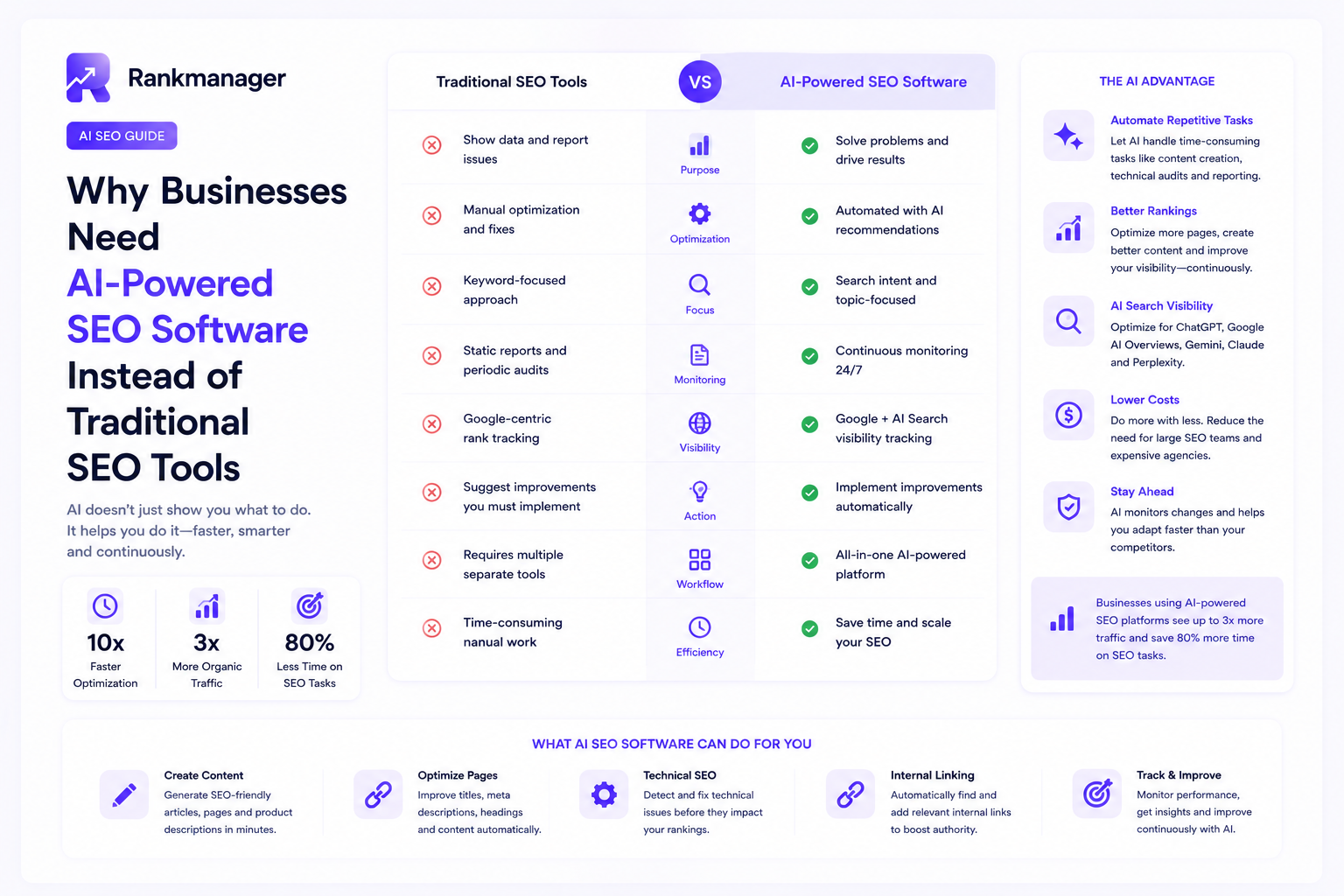
Why Businesses Need AI-Powered SEO Software Instead of Traditional SEO Tools
Why Businesses Need AI-Powered SEO Software Instead of Traditional SEO Tools
Introduction
Search has fundamentally changed.
For years, SEO success depended on ranking well in Google. Businesses relied on traditional SEO tools to monitor keywords, analyze backlinks, and optimize webpages.
While those tools are still useful, they’re no longer enough.
Today’s customers don’t just search on Google—they ask questions in ChatGPT, Google AI Overviews, Gemini, Claude, and Perplexity. They expect immediate answers instead of scrolling through pages of search results.
At the same time, SEO has become more complex than ever. Businesses must create content, monitor technical issues, build authority, optimize for AI Search, and keep their websites continuously updated.
Traditional SEO tools were built for yesterday’s internet.
AI-powered SEO platforms are built for the future.
In this guide, we’ll explain why businesses are moving away from traditional SEO software and embracing AI-powered automation.
The Evolution of SEO
SEO has gone through several major phases.
Phase 1: Keywords
Businesses focused on keyword density and backlinks.
Phase 2: User Experience
Google rewarded fast, mobile-friendly, helpful websites.
Phase 3: AI Search
Today, visibility extends beyond Google.
Success now depends on being trusted by both search engines and AI-powered search platforms.
SEO software has had to evolve as well.
The Problem with Traditional SEO Tools
Most traditional SEO tools were designed to provide data.
They help you discover problems.
But they don’t solve them.
For example, a traditional SEO platform may tell you:
- Your page is missing a meta description.
- You have broken links.
- Your content is outdated.
- Your page speed is slow.
- You’re missing internal links.
The next step?
You still have to fix everything manually.
That takes time.
AI-Powered SEO Does More Than Report Problems
Modern AI SEO platforms don’t just identify issues.
They help resolve them automatically.
Instead of showing:
“You should improve this page.”
AI can actually:
- Generate better content
- Rewrite titles
- Suggest internal links
- Optimize meta descriptions
- Detect technical issues
- Recommend content updates
- Build topic clusters
This transforms SEO from a manual process into an automated workflow.
1. AI Creates Content Faster
One of the biggest advantages of AI SEO software is content generation.
Instead of staring at a blank page, AI can create:
- Blog articles
- Product descriptions
- Category pages
- Landing pages
- FAQs
- Meta descriptions
Your team spends less time writing and more time reviewing and improving.
2. AI Continuously Optimizes Existing Content
Publishing content isn’t enough.
Successful websites continually improve existing pages.
AI can identify:
- Missing sections
- Outdated information
- Weak headings
- Missing keywords
- Internal linking opportunities
- Readability improvements
Instead of performing annual content audits, optimization becomes continuous.
3. AI Automates Technical SEO
Technical SEO is often neglected because it’s repetitive.
AI platforms continuously monitor your website for:
- Broken links
- Missing metadata
- Redirect issues
- Crawl errors
- Duplicate titles
- Missing alt text
- Indexing problems
Rather than discovering issues months later, you’re notified immediately.
4. AI Understands Search Intent
Traditional SEO often focused heavily on keywords.
Modern AI focuses on intent.
Instead of optimizing for:
“AI SEO software”
AI understands broader questions like:
“What’s the best SEO platform for a growing WordPress business?”
This leads to content that’s more useful for readers and more valuable for AI Search.
5. AI Helps You Rank Beyond Google
Traditional SEO tools focus primarily on Google rankings.
Modern businesses also need visibility in:
- ChatGPT
- Google AI Overviews
- Gemini
- Claude
- Perplexity
AI-powered SEO software helps optimize your website for these emerging discovery platforms.
6. AI Never Stops Monitoring
SEO isn’t something you do once.
Websites change daily.
Competitors publish new content.
Google updates its algorithms.
AI-powered SEO software monitors your website 24/7 and alerts you when improvements are needed.
That means fewer surprises and faster action.
7. AI Builds Stronger Topic Clusters
Topical authority has become one of the most important ranking signals.
AI can automatically identify:
- Missing content
- Related topics
- Supporting articles
- Internal links
- Pillar pages
Instead of publishing isolated blog posts, your website develops into a complete knowledge hub.
8. AI Saves Time
Perhaps the biggest benefit of AI SEO software is efficiency.
Tasks that previously took hours can now take minutes.
Examples include:
- Writing articles
- Optimizing metadata
- Finding internal links
- Generating reports
- Updating existing content
This allows marketing teams to focus on strategy rather than repetitive work.
Traditional SEO Tools vs AI SEO Platforms
| Traditional SEO Tools | AI-Powered SEO Platforms |
|---|---|
| Show data | Solve problems |
| Manual optimization | Automated optimization |
| Keyword-focused | Search intent-focused |
| Static reports | Continuous monitoring |
| Google-centric | Google + AI Search |
| Suggest improvements | Implement recommendations |
| Requires multiple tools | All-in-one workflow |
The difference is clear.
Traditional tools tell you what to do.
AI platforms help you actually do it.
Why Small Businesses Benefit Even More
Large companies often have dedicated SEO teams.
Small businesses don’t.
AI levels the playing field.
A small team can now:
- Produce more content
- Optimize more pages
- Monitor technical SEO
- Build authority faster
Without dramatically increasing costs.
AI Doesn’t Replace SEO Experts
One common misconception is that AI replaces SEO professionals.
It doesn’t.
Instead, AI removes repetitive work.
Humans still provide:
- Strategy
- Creativity
- Industry expertise
- Brand voice
- Business decisions
The best results come from combining AI efficiency with human knowledge.
What to Look for in AI SEO Software
Not all AI SEO tools are the same.
Look for a platform that offers:
- AI content generation
- Technical SEO monitoring
- Internal linking automation
- AI Search optimization
- Content planning
- Competitor analysis
- Reporting dashboards
- WordPress integration
- Continuous optimization
The more workflows you can automate, the greater the long-term value.
Why Rankmanager Is Different
Rankmanager isn’t just another SEO reporting tool.
It’s an AI-powered optimization platform designed for both traditional search engines and the future of AI Search.
With Rankmanager, you can:
- Generate SEO-friendly content
- Optimize existing pages automatically
- Improve internal linking
- Detect technical SEO issues
- Build topical authority
- Discover content opportunities
- Monitor AI visibility
- Optimize WordPress websites
- Stay ahead of search algorithm changes
Instead of spending hours manually managing SEO, Rankmanager helps your website improve continuously.
Frequently Asked Questions
What is AI-powered SEO software?
AI-powered SEO software uses artificial intelligence to automate optimization tasks such as content creation, technical SEO monitoring, internal linking, and AI Search optimization.
Is AI SEO better than traditional SEO tools?
Traditional SEO tools remain useful for reporting and analysis, but AI-powered platforms add automation, recommendations, and continuous optimization, making them more efficient for most businesses.
Can AI completely automate SEO?
Not entirely. AI automates repetitive tasks, while strategy, creativity, and business expertise still require human input.
Do I still need Google Search Console?
Yes. Google Search Console remains an essential source of data, even when using AI-powered SEO software.
Is AI SEO only for large companies?
No. Small businesses often benefit the most because AI allows them to compete with larger organizations without needing large SEO teams.
Final Thoughts
The SEO landscape has changed dramatically.
Traditional SEO tools were built to help you analyze websites.
Modern AI-powered SEO platforms help you improve them.
As search continues to evolve beyond Google and into AI-powered experiences, businesses need software that goes beyond reporting.
They need automation.
They need continuous optimization.
They need AI.
The future belongs to businesses that spend less time managing SEO—and more time growing their business.
That’s exactly what AI-powered SEO software is designed to do.


Scalability for Growing Businesses
As businesses grow, their needs evolve. SaaS tools are designed to scale alongside organizations, allowing them to add users, features, and integrations without major disruptions. This flexibility ensures that companies can maintain productivity even during periods of rapid growth. There’s no need for costly infrastructure upgrades or complicated migrations—everything adapts seamlessly.
- Keep tasks, files, and communication in one place to reduce time spent switching between tools.
- Automate routine processes like data entry, notifications, and reporting to save time.
- Enable teams to work together instantly, improving communication and reducing delays.
- Access your work from anywhere, allowing flexibility and remote productivity.
- Use real-time analytics and insights to make informed and timely decisions.
SaaS tools allow employees to work from anywhere, whether in the office, at home, or on the move. This flexibility not only improves productivity but also supports better work-life balance. With mobile access and cloud synchronization, users can stay connected and productive without being tied to a specific location. Unlike traditional software, SaaS platforms are constantly evolving. Providers regularly release updates, introduce new features, and improve performance without disrupting users.
Improving productivity is not about working harder—it’s about working smarter. SaaS tools provide the foundation for modern, efficient workflows by combining automation, collaboration, accessibility, and data-driven insights.