


EU AI Act and AI-Generated Content: What Businesses Need to Know in 2026
The EU AI Act’s provisions on AI-generated content came into full effect for most businesses in 2025 and 2026. If your organisation creates, distributes, or relies on AI-generated text, images, video, or audio, you are almost certainly subject to obligations you need to understand — and act on — now.
Introduction to the EU AI Act 2026: Key Updates

The EU AI Act (Regulation 2024/1689) is the world’s first comprehensive legal framework governing artificial intelligence. Its risk-based approach classifies AI systems into four tiers — unacceptable risk, high risk, limited risk, and minimal risk — and assigns compliance obligations accordingly.
For businesses working with AI-generated content, the most immediately relevant provisions are those covering General Purpose AI (GPAI) models and transparency obligations under Article 50. The August 2025 deadline marked the point at which GPAI model rules and transparency requirements became enforceable. By 2026, national market surveillance authorities across EU member states are actively investigating non-compliance.
Key 2026 updates include clarified guidance from the European AI Office on what constitutes adequate disclosure, updated technical standards for synthetic media detection, and the first published enforcement decisions — some carrying fines in the millions of euros.
What is AI-Generated Content Under the New Regulation?
The Act does not use the phrase “AI-generated content” as a defined term, but Article 3 and Article 50 together make clear what is covered. AI-generated content, for compliance purposes, means any text, image, audio, video, or other output produced by an AI system that could reasonably be mistaken for human-created material.
This includes:
- Marketing copy, blog posts, and product descriptions written by large language models
- Synthetic images and illustrations generated by diffusion models
- Deepfake videos or voice clones used in advertising or communications
- AI-generated news summaries or legal documents
- Chatbot responses presented to consumers or employees
Notably, the Act treats deepfakes more strictly than other AI-generated content. Any realistic synthetic representation of a real person requires explicit disclosure, regardless of context. For other types of AI-generated content — such as a blog article drafted by an LLM — the disclosure obligation applies when there is a meaningful risk of confusion about the content’s origin.
Business Compliance Requirements for AI-Generated Content
The compliance burden depends partly on your role in the AI value chain. The Act distinguishes between providers (those who develop or place AI systems on the market) and deployers (those who use AI systems in their operations). Most businesses producing AI-generated content are acting as deployers, which carries its own set of obligations.
Core requirements for deployers using AI to generate content include:
- Transparency to end users: Where an AI system interacts with people in real time — such as a customer-facing chatbot — users must be informed they are communicating with an AI, unless this is obvious from context.
- Disclosure of synthetic media: AI-generated images, video, and audio must be labelled as machine-made, using machine-readable markers where technically feasible.
- Record-keeping: Businesses must maintain logs demonstrating how and where AI-generated content has been used, particularly in regulated sectors.
- Human oversight: High-impact uses of AI-generated content — for example, AI-written credit assessments or recruitment materials — require documented human review processes.
- Data governance: If your AI tools were trained on personal data, you have additional obligations under both the Act and GDPR that run concurrently.
Step-by-Step Guide to Aligning Your Business with the EU AI Act
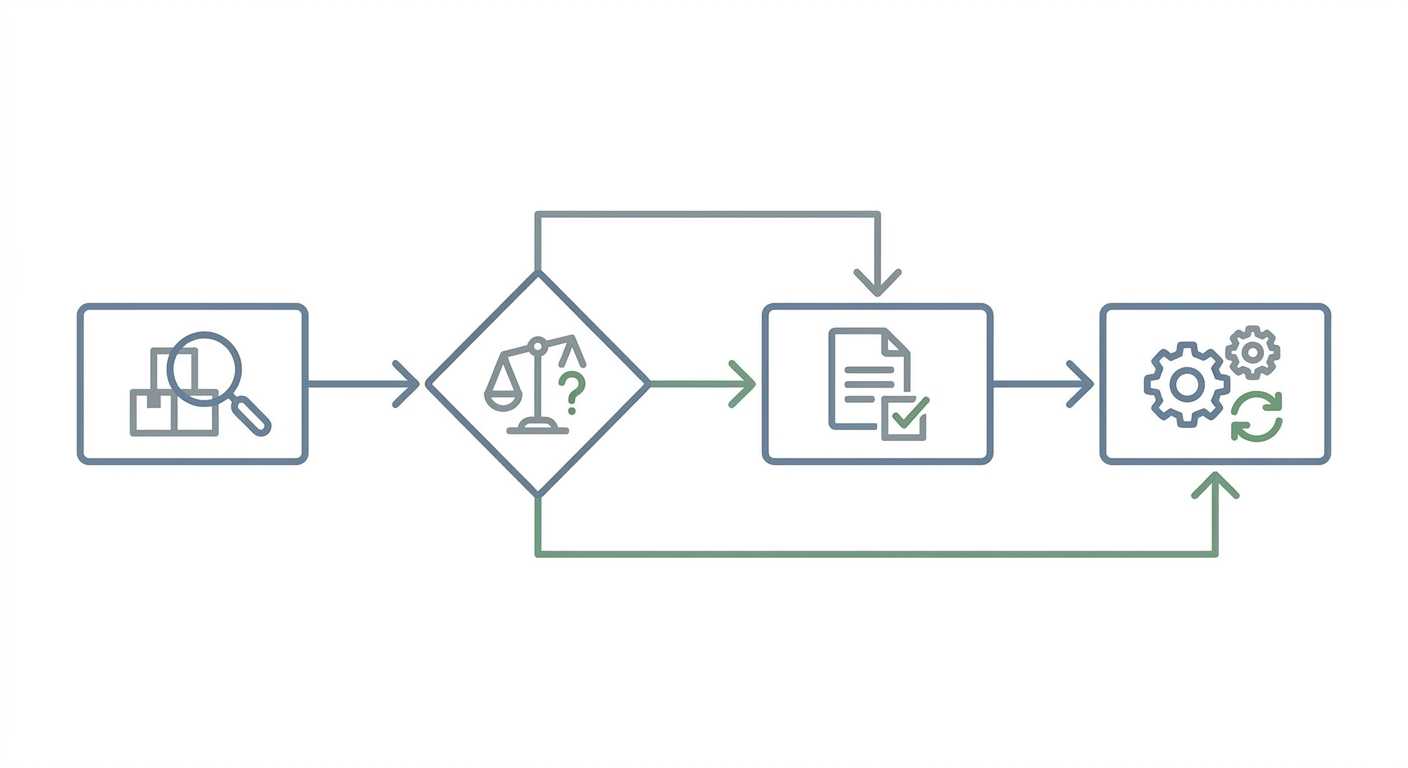
Compliance doesn’t have to be overwhelming. The approach below works whether you’re a sole trader using an AI writing tool or a mid-sized company running multiple AI-powered workflows.
- Audit your AI use. List every AI tool your business uses to create or process content. Include writing assistants, image generators, chatbots, translation tools, and any AI features embedded in platforms like CRMs or email marketing software.
- Classify by risk. For each tool, determine which risk tier applies. Most general-purpose content tools fall under limited risk, but AI used in hiring, credit, healthcare, or legal contexts may be classified as high risk.
- Map your disclosure obligations. Identify where AI-generated content reaches end users — your website, emails, social media, customer support — and assess whether disclosures are currently in place.
- Implement technical labelling. For images and video, begin embedding machine-readable provenance data (C2PA standards are increasingly referenced by the European AI Office as best practice).
- Update your policies. Your privacy policy, terms of service, and any customer-facing documentation should reflect your use of AI-generated content.
- Train your team. Staff who commission, edit, or publish AI-generated content need to understand what the Act requires. Brief training sessions and an internal policy document are a practical starting point.
- Establish a review cadence. EU AI Act guidance is evolving. Set a quarterly review to check for new technical standards, enforcement decisions, and updated guidance from the European AI Office.
Smaller businesses can work through these steps over a few weeks. Larger organisations with multiple product lines may need a formal project with legal input. Either way, starting with an honest audit is always the right first step.
Risks and Penalties for Non-Compliance
The financial penalties under the EU AI Act are significant — and they’re designed to be proportionate to company size, so large businesses face larger fines.
| Violation Type | Maximum Fine (Organisations) | Cap for SMEs |
|---|---|---|
| Prohibited AI practices (e.g. subliminal manipulation) | €35 million or 7% of global annual turnover | Lower of the two figures applies |
| Failure to meet obligations for high-risk AI systems | €15 million or 3% of global annual turnover | Lower of the two figures applies |
| Providing incorrect information to authorities | €7.5 million or 1.5% of global annual turnover | Lower of the two figures applies |
| Transparency failures (AI-generated content labelling) | Up to €15 million or 3% of global annual turnover | Lower of the two figures applies |
Beyond financial penalties, businesses face reputational risk. The first high-profile enforcement cases — particularly those involving undisclosed deepfakes or AI-generated disinformation — have attracted significant press coverage. Consumer trust, once lost, is difficult to rebuild.
Case Studies: How Businesses Are Adapting to the EU AI Act
The following examples illustrate how businesses of different sizes are responding to the Act’s requirements. Details have been anonymised where organisations have not made their compliance approach public.
A mid-sized e-commerce retailer
A European fashion retailer using AI to generate product descriptions and social media copy conducted a full content audit in early 2025. They found that roughly 60% of their published content had been AI-assisted but carried no disclosure. They introduced a brief “AI-assisted content” label in their site footer and on individual product pages, and added provenance metadata to all AI-generated images. Legal review cost approximately two weeks of in-house counsel time. No external enforcement action followed.
A B2B SaaS company
A software company using an LLM-powered support chatbot updated its chat interface to include a clear opening message identifying the bot as an AI system. They also updated their data processing agreements with the LLM provider to reflect the Act’s requirements around third-party accountability. The project took around six weeks end to end.
A content marketing agency
An agency producing AI-assisted articles for client websites developed an internal policy requiring human editorial sign-off on all AI-generated drafts before publication. They also introduced client disclosure templates so that clients could add appropriate notices to their own sites. The agency now positions this compliance work as a service differentiator.
Comparison of 2026 EU AI Act vs Earlier AI Regulations
| Feature | Pre-2024 EU Approach | EU AI Act 2026 |
|---|---|---|
| Legal basis | Fragmented — GDPR, sector-specific rules | Single comprehensive regulation |
| AI-generated content disclosure | No specific requirement | Mandatory for synthetic media and consumer-facing chatbots |
| Risk classification | None | Four-tier system (unacceptable, high, limited, minimal) |
| GPAI model obligations | None | Transparency, copyright summaries, systemic risk rules for largest models |
| Enforcement body | National data protection authorities (GDPR) | European AI Office + national market surveillance authorities |
| Maximum fine | €20 million or 4% turnover (GDPR) | €35 million or 7% turnover (for most serious violations) |
| SME provisions | Limited | Explicit reduced obligations and regulatory sandboxes |
Your EU AI Act Compliance Checklist
Use the checklist below as a starting point. A downloadable version is available — ask your account manager or contact us directly to request the full toolkit.
- ☐ Completed an audit of all AI tools used in content creation
- ☐ Classified each AI use case by risk tier
- ☐ Identified all touchpoints where AI-generated content reaches end users
- ☐ Added visible disclosures to consumer-facing AI interactions (chatbots, generated pages)
- ☐ Implemented machine-readable labelling on AI-generated images and video
- ☐ Updated privacy policy and terms of service to reflect AI use
- ☐ Briefed relevant staff on their obligations under the Act
- ☐ Established a review schedule for monitoring regulatory updates
- ☐ Reviewed third-party AI provider contracts for compliance clauses
- ☐ Documented human oversight processes for high-risk AI outputs
FAQ
Does the EU AI Act apply to my business if I’m outside the EU?
Yes, if your AI-generated content is made available to users in the EU — regardless of where your business is based — the Act applies to you. This extraterritorial scope mirrors the approach taken by GDPR and means that businesses in the UK, US, and elsewhere need to take the regulation seriously if they serve European customers.
Do I need to label every piece of AI-generated content?
Not necessarily every piece, but the bar is lower than many businesses assume. The Act requires disclosure where there is a meaningful risk that users could mistake AI-generated content for human-created material. Synthetic images, deepfake video, voice clones, and real-time AI interactions with consumers all require clear disclosure. AI-assisted drafts reviewed and substantially edited by a human sit in a more ambiguous position — but documented human oversight significantly reduces your risk.
What counts as adequate disclosure under the EU AI Act?
The Act requires that disclosures are clear, visible, and machine-readable where technically feasible. A small grey footnote is unlikely to satisfy regulators. The European AI Office has indicated that disclosures should be prominent enough that a reasonable user would notice them without actively searching. For synthetic media, embedding C2PA-compliant provenance metadata alongside any visible label is currently considered best practice.
Are there any exemptions for small businesses?
The Act includes specific provisions for SMEs and start-ups, including access to regulatory sandboxes and reduced administrative burdens in certain areas. However, the core transparency obligations — particularly around synthetic media and consumer-facing AI — apply regardless of company size. Fines are capped at the lower of the fixed amount or the percentage of turnover, which provides some proportionality for smaller organisations.
How does the EU AI Act interact with GDPR?
The two regulations run concurrently and both may apply to your AI-generated content activities. Where AI systems process personal data — for example, an AI trained on customer information — you need to satisfy both frameworks. In practice, your data protection officer (or equivalent) should be involved in any EU AI Act compliance project from the outset. The European Data Protection Board has published guidance on areas of overlap.


The EU AI Act is the world’s first comprehensive legal framework governing artificial intelligence — and if your business creates, deploys, or distributes AI-generated content, the 2026 obligations apply to you directly. Understanding what the regulation requires, and acting on it before enforcement deadlines hit, is no longer optional.
Introduction to the EU AI Act 2026: Key Updates
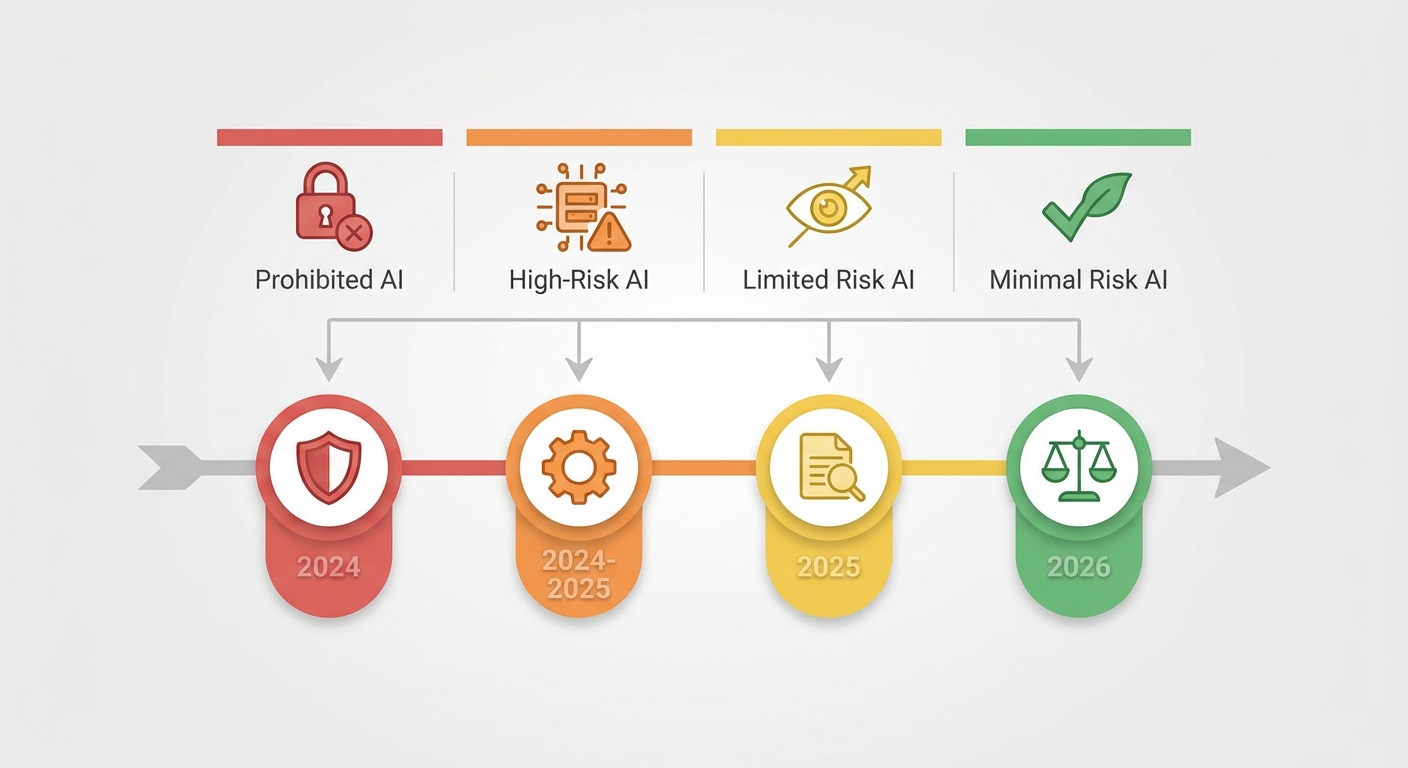
The EU AI Act entered into force in August 2024, but its obligations are rolling out in phases. By 2026, the rules covering general-purpose AI (GPAI) models and high-risk AI systems are fully applicable. This means businesses that use large language models, image generators, or automated content tools to produce material for customers or internal use must now meet specific transparency, documentation, and disclosure requirements.
The 2026 updates bring three areas into sharper focus. First, the obligations for providers and deployers of GPAI models are now active, covering everything from technical documentation to copyright compliance policies. Second, the rules on AI-generated content disclosure — particularly synthetic media and deepfakes — carry real enforcement weight. Third, national competent authorities across EU member states have been designated and are actively building enforcement capacity.
If your business operates anywhere in the EU, sells to EU customers, or processes EU residents’ data using AI tools, the Act applies regardless of where your company is headquartered.
What Is AI-Generated Content Under the New Regulation?
The EU AI Act doesn’t use the phrase “AI-generated content” as a standalone defined term, but the framework covers it across several provisions. For practical purposes, AI-generated content means any text, image, audio, video, or synthetic media produced or substantially shaped by an AI system — including outputs from tools like large language models, image synthesis platforms, and automated translation or summarisation systems.
Where the regulation gets specific is around deepfakes and synthetic media. Article 50 of the Act requires that AI systems generating or manipulating image, audio, or video content must label their outputs as artificially generated, except in narrow circumstances. The same provision requires chatbots and AI interaction systems to be transparent with users about the fact they are not talking to a human.
For written content — blog posts, product descriptions, news articles — the disclosure requirements are less prescriptive but are supported by the Act’s broader transparency obligations. Businesses using AI to produce content at scale should treat clear disclosure as the safer, and more future-proof, position.
Business Compliance Requirements for AI-Generated Content
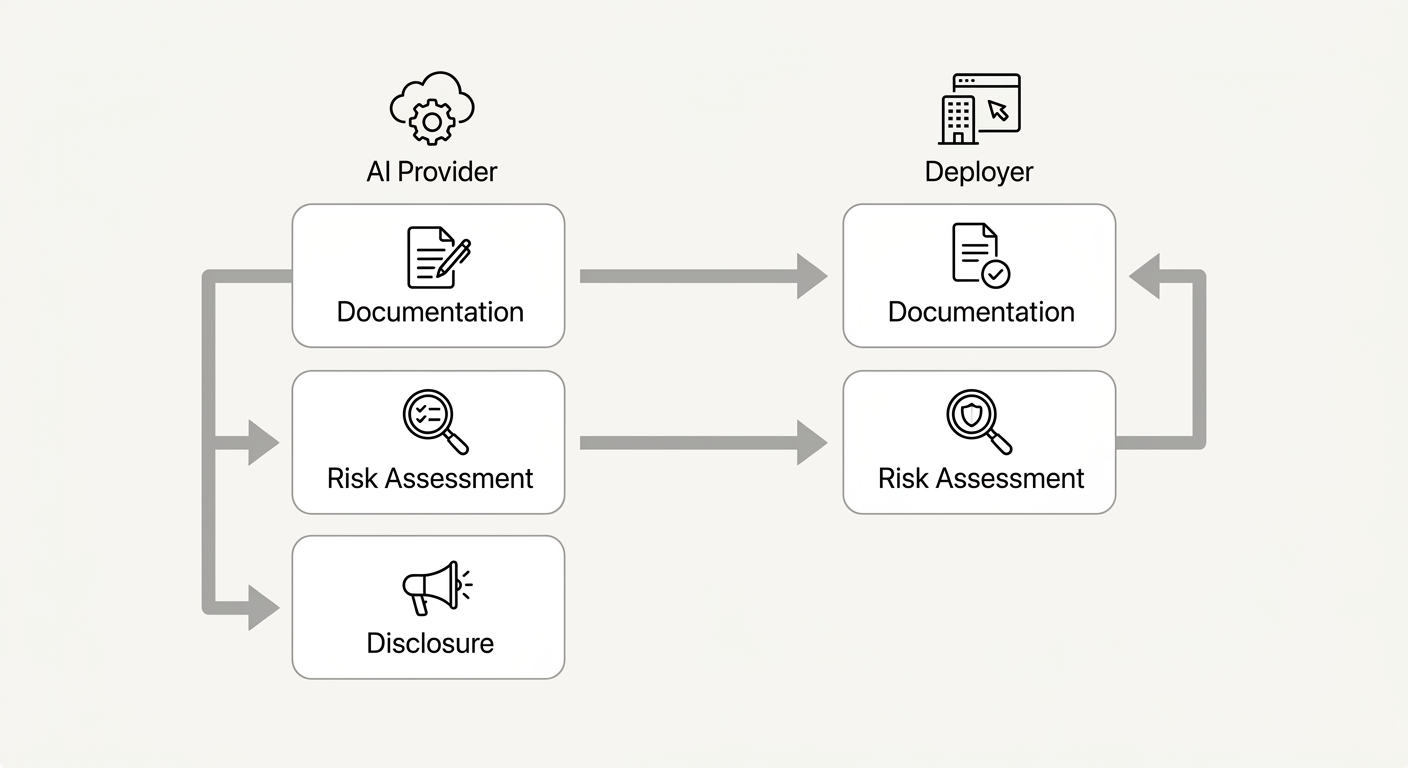
The Act distinguishes between two main roles: providers (those who develop or place AI systems on the market) and deployers (those who use AI systems in a professional context). Most businesses producing AI-generated content sit in the deployer category, though companies that fine-tune or customise foundational models may carry additional obligations.
As a deployer, your core compliance responsibilities include:
- Transparency to end users: Users must know when they’re interacting with or receiving content from an AI system, particularly for chatbots and synthetic media.
- Human oversight: High-risk AI applications — including some content moderation and candidate screening tools — require meaningful human review before decisions affecting people are made.
- Data governance: AI systems used in regulated contexts must operate on data that meets quality and relevance standards.
- Record-keeping: Logs of AI system use in high-risk contexts must be retained for defined periods and made available to authorities on request.
- Conformity with provider instructions: Deployers must use AI systems within the scope their provider has defined and must not use them in ways that increase risk without additional safeguards.
For content specifically, the practical implication is this: if you’re publishing AI-generated text, images, or video to an audience — especially in commercial, journalistic, or public-interest contexts — you need a disclosed, documented process for how that content is produced, reviewed, and corrected if it’s wrong.
Step-by-Step Guide to Aligning Your Business with the EU AI Act
Compliance doesn’t need to be paralysing, but it does need to be systematic. The following steps apply whether you’re a small business using a single AI writing tool or a larger organisation running multiple automated content pipelines.
- Audit your AI tools. List every AI system your business uses that touches content creation, customer interaction, or internal decision-making. Include third-party tools, plugins, and APIs.
- Classify your use cases by risk. The Act defines four risk tiers: unacceptable risk (banned), high risk (strict obligations), limited risk (transparency obligations), and minimal risk (largely unregulated). Most AI-generated content tools fall into the limited or minimal risk categories, but confirm this for each tool.
- Check your providers’ documentation. Providers of GPAI models are now required to publish technical documentation, usage policies, and copyright compliance information. Review these for every AI system you deploy.
- Implement disclosure practices. Where the Act requires it — and where best practice suggests it — add clear, plain-language disclosures when content is AI-generated or when users are interacting with an AI system.
- Assign accountability internally. Someone in your organisation needs to own AI compliance. This doesn’t require a dedicated hire for most SMEs, but responsibilities must be documented and not left ambiguous.
- Train relevant staff. Teams producing or reviewing AI-generated content should understand both the regulatory requirements and the internal processes your business has established.
- Document and review. Keep records of your compliance decisions, tool assessments, and review processes. Revisit them at least annually, or when you adopt a new AI tool.
Smaller businesses often worry that compliance is designed for large enterprises with legal teams. In practice, the Act’s proportionality principle means obligations scale with the risk and scale of your AI use. A five-person content agency using an AI writing assistant faces a very different compliance picture than a fintech firm using AI to assess loan applications.
Risks and Penalties for Non-Compliance
The EU AI Act’s penalty structure is graduated, but the upper figures are significant. Violations involving prohibited AI practices can attract fines of up to €35 million or 7% of global annual turnover, whichever is higher. Breaches of other obligations — including transparency and documentation requirements most relevant to AI-generated content — carry fines of up to €15 million or 3% of global annual turnover.
Providing incorrect or misleading information to supervisory authorities is penalised at up to €7.5 million or 1.5% of turnover. For SMEs and startups, the Act specifies that the lower of the two thresholds (fixed amount vs. turnover percentage) applies, which offers some protection — but not immunity.
Beyond financial penalties, non-compliance carries reputational risk. As AI disclosure becomes a more visible issue for consumers and journalists, businesses that can’t demonstrate a clear, documented approach will find themselves on the wrong side of a fast-moving public debate.
Comparison of 2026 EU AI Act vs Earlier AI Regulations
| Aspect | Pre-2024 EU AI Landscape | EU AI Act 2026 (Fully Applied) |
|---|---|---|
| Legal basis | Sector-specific rules (GDPR, product liability, media law) | Horizontal regulation covering all AI systems by risk tier |
| AI-generated content disclosure | No specific obligation; covered loosely by consumer protection law | Mandatory disclosure for synthetic media and AI chatbots (Article 50) |
| GPAI model obligations | None | Technical documentation, copyright policy, systemic risk assessment for frontier models |
| Enforcement | Fragmented across national authorities by sector | Dedicated national competent authorities + European AI Office |
| Penalties | Varied by sector; GDPR max 4% of turnover | Up to 7% of global turnover for most serious violations |
| Scope | EU-established entities primarily | Extra-territorial: applies where output affects EU users |
| Human oversight requirements | GDPR right to explanation for automated decisions | Mandatory human oversight for high-risk AI applications |
Case Studies: How Businesses Are Adapting to the EU AI Act
The following examples illustrate how businesses across different sectors are approaching compliance. Names have been omitted as these are composite scenarios based on publicly reported industry patterns.
A mid-sized European media publisher producing AI-assisted news summaries introduced a two-step process: AI drafts the summary, an editor reviews and approves before publication, and a visible label reads “Produced with AI assistance, reviewed by editorial staff.” This satisfies both the Act’s transparency requirements and their editorial standards policy.
A B2B SaaS company using an AI chatbot for customer support added a clear opening message — “You’re chatting with an AI assistant” — and built an escalation path to a human agent for complex queries. They also reviewed their chatbot provider’s GPAI documentation to confirm the system was compliant at the model level.
A boutique e-commerce brand using AI-generated product descriptions decided the disclosure burden was low-risk for their use case (minimal risk tier) but implemented an internal review process to catch factual errors before listings went live. Their approach: treat compliance as a content quality measure, not just a legal one.
The common thread across all three is that compliance doesn’t require abandoning AI tools — it requires building a documented, human-in-the-loop process around them.
📥 Downloadable Compliance Checklist: We’ve put together a practical EU AI Act compliance checklist for businesses producing AI-generated content. Download it here to keep your team aligned and audit-ready.
Frequently Asked Questions
Does the EU AI Act apply to my business if I’m based outside the EU?
Yes, if your AI system’s output reaches users in the EU — whether through a website, app, or service — the Act’s obligations apply. This extra-territorial scope mirrors how GDPR works in practice. If you have EU customers or EU-based employees who interact with AI systems, you’re in scope.
Do I have to label every piece of AI-generated content?
Not necessarily every piece. The Act’s explicit labelling requirements target synthetic media (images, audio, video that depict real or realistic scenarios) and AI-chatbot interactions. For AI-assisted written content, the direct legal obligation is less prescriptive, but transparency is strongly implied by the Act’s broader principles — and increasingly expected by audiences.
What counts as a “high-risk” AI system under the 2026 rules?
High-risk systems are those used in areas like employment decisions, credit scoring, education assessment, law enforcement, and critical infrastructure. Most AI content generation tools don’t meet this threshold. However, if you’re using AI to personalise content in ways that materially affect access to services — insurance communications, loan offer copy — you may be closer to the line than you think.
How long do I need to keep records of AI system use?
For high-risk AI systems, the Act requires logs to be kept for at least six months where technically feasible. For other categories, the Act doesn’t specify a uniform retention period, but general data protection and business record obligations still apply. Maintaining clear records of how and when AI tools are used in content production is good practice regardless.
Is there a grace period for SMEs to become compliant?
The Act includes proportionality provisions and some phased timelines, and the European AI Office has signalled a focus on education and guidance for SMEs before aggressive enforcement. That said, the obligations themselves are not suspended — and the longer compliance is delayed, the harder it becomes to demonstrate good faith if a complaint is raised.