

SEO vs GEO: What’s the Difference and Why You Need Both
SEO vs GEO: What’s the Difference and Why You Need Both
Published: 2026
SEO vs GEO: What’s the Difference?
For more than two decades, businesses have focused on one primary goal: ranking higher in Google.
Today, search is evolving.
Millions of people now use AI-powered platforms such as ChatGPT, Google AI Overviews, Gemini, Claude, and Perplexity to find answers instead of browsing through multiple websites. Rather than presenting a list of links, these platforms generate complete responses by combining information from trusted sources.
This shift has introduced a new discipline called Generative Engine Optimization (GEO).
Does this mean SEO is becoming obsolete?
Not at all.
SEO and GEO work together. Traditional SEO helps search engines understand and rank your website, while GEO helps AI systems understand, trust, and recommend your content.
Businesses that invest in both will be far better prepared for the future of search.
What Is SEO?
Search Engine Optimization (SEO) is the process of improving your website so it appears higher in traditional search engines like Google and Bing.
The objectives remain familiar:
- Increase organic traffic
- Improve keyword rankings
- Generate more qualified leads
- Grow online visibility
- Increase conversions
SEO combines technical improvements with high-quality content and a great user experience.
A modern SEO strategy includes:
- Technical SEO
- Keyword research
- High-quality content
- Internal linking
- Page speed optimization
- Mobile optimization
- Schema markup
- Backlink building
- User experience improvements
Although Google’s algorithms continue to evolve, these principles remain the foundation of successful websites.
What Is GEO?
Generative Engine Optimization (GEO) focuses on optimizing your content so AI-powered search engines are more likely to reference it when generating answers.
Instead of competing only for rankings, GEO aims to make your website a trusted source of information.
AI platforms that rely on this type of optimization include:
- ChatGPT
- Google AI Overviews
- Gemini
- Claude
- Perplexity
Rather than displaying ten links, these platforms analyze trusted sources and generate one complete answer.
Your goal is to become one of those trusted sources.
Why GEO Is Becoming Essential
The way people search has changed dramatically.
Instead of typing:
“Best CRM software”
Users increasingly ask:
“What’s the best CRM for a small business with less than twenty employees?”
Instead of searching for:
“WordPress SEO plugin”
They ask:
“Which AI SEO platform is best for WordPress websites?”
These longer, conversational questions are exactly what AI platforms are designed to answer.
Businesses that optimize only for traditional rankings risk becoming less visible as AI Search adoption continues to grow.
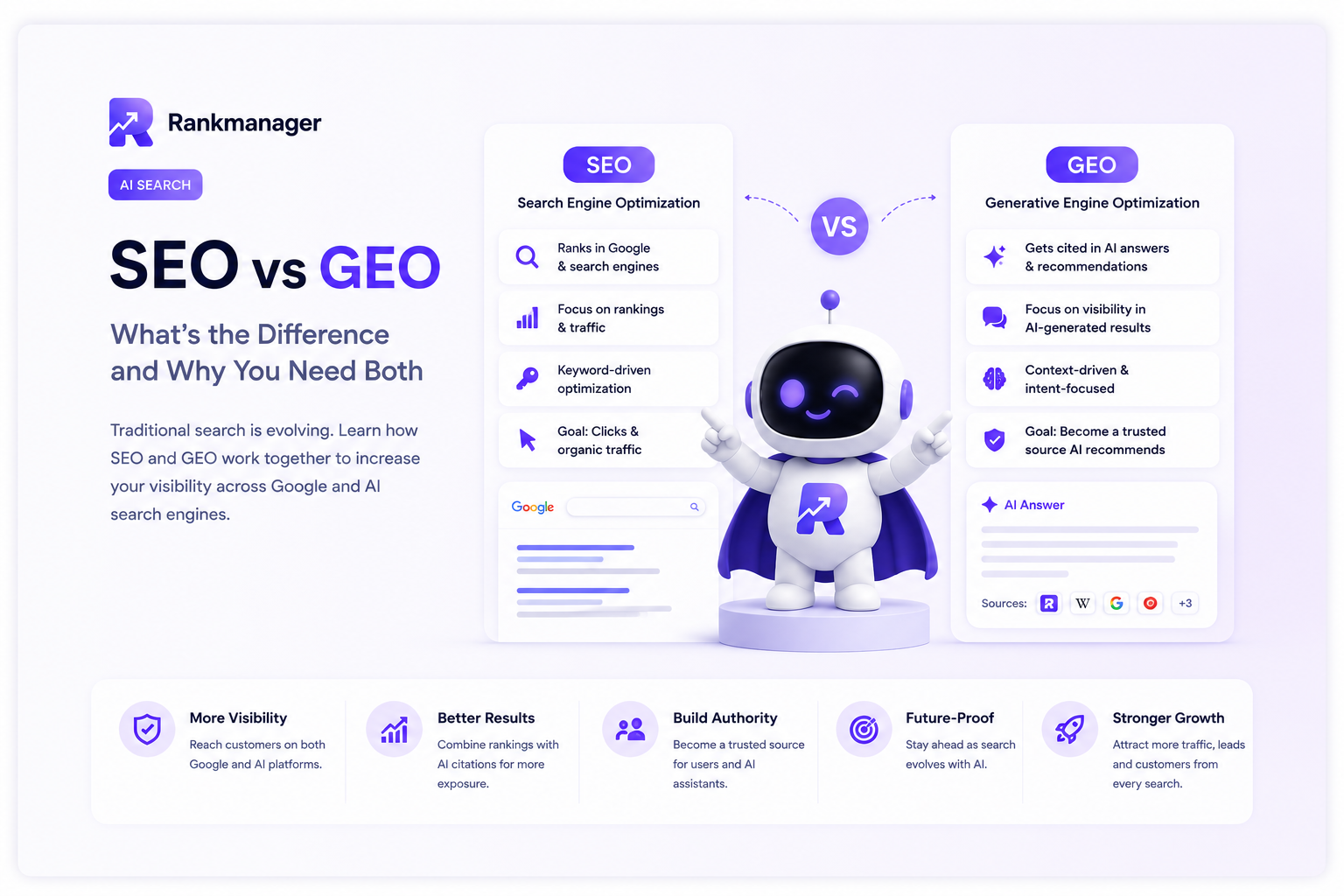
SEO vs GEO
| SEO | GEO |
|---|---|
| Optimizes for search engines | Optimizes for AI search platforms |
| Focuses on rankings | Focuses on recommendations and citations |
| Keyword-driven | Context-driven |
| Optimizes pages | Optimizes knowledge and authority |
| Clicks are the goal | Becoming a trusted source is the goal |
| Google & Bing | ChatGPT, Gemini, Claude, Perplexity & Google AI |
SEO helps people find your website.
GEO helps AI recommend your business.
The strongest strategy combines both.
How SEO and GEO Work Together
Many marketers believe GEO will replace SEO.
That isn’t the case.
Without solid SEO, AI systems have difficulty discovering and understanding your website.
Think of SEO as the foundation of your online presence.
GEO builds on top of that foundation.
A technically healthy website with authoritative content has a much greater chance of being cited by AI systems than a poorly optimized website.
The future isn’t SEO or GEO.
It’s SEO and GEO.
What Still Matters for SEO
Traditional SEO remains essential because AI systems still rely on high-quality websites.
Focus on:
Technical SEO
Your website should be:
- Fast
- Secure
- Mobile-friendly
- Easy to crawl
- Properly indexed
Content Quality
Create content that genuinely helps users solve problems.
Quality will always outperform quantity.
Keyword Research
Understanding what your audience searches for remains valuable.
However, it’s now equally important to understand the questions people ask AI assistants.
Internal Linking
A strong internal linking structure helps both search engines and AI understand the relationship between topics on your website.
User Experience
Fast loading times, readable layouts and intuitive navigation improve both rankings and engagement.
What Matters Most for GEO
While GEO shares many SEO principles, it places greater emphasis on trust, expertise and context.
Answer Real Questions
Write content that directly answers user questions instead of simply targeting keywords.
AI platforms prefer useful answers over keyword density.
Build Topic Authority
Instead of publishing isolated blog posts, build complete topic clusters.
For example:
AI Search
- What Is AI Search?
- SEO vs GEO
- How to Rank in ChatGPT
- AI Search Ranking Factors
- AI SEO Checklist
This structure helps AI understand your expertise.
Keep Content Fresh
Regularly update your content with:
- New statistics
- Industry developments
- Product updates
- Current best practices
Fresh information is more likely to be trusted.
Write Naturally
Write for people first.
Avoid:
- Keyword stuffing
- Over-optimized copy
- Robotic AI content
Natural language performs better in AI-powered search.
Demonstrate Expertise
AI increasingly rewards websites that demonstrate genuine experience.
Include:
- Expert insights
- Original research
- Practical examples
- Case studies
- Real-world experience
Why Authority Matters More Than Ever
Modern AI systems don’t simply repeat the highest-ranking webpage.
They evaluate whether a website demonstrates:
- Expertise
- Trustworthiness
- Accuracy
- Consistency
- Topical authority
Businesses that consistently publish valuable content across a subject are much more likely to become trusted sources.
One great article isn’t enough.
Authority is built over time.
Common SEO Mistakes in the AI Era
Many businesses continue using outdated SEO tactics.
Common mistakes include:
- Publishing low-quality AI-generated articles
- Ignoring technical SEO
- Writing only for keywords
- Creating duplicate content
- Never updating older articles
- Weak internal linking
- Focusing exclusively on Google rankings
These strategies become less effective as AI Search continues to grow.
The Future of Search
Google Search isn’t disappearing.
Instead, search is expanding.
People now discover businesses through:
- Google Search
- Google AI Overviews
- ChatGPT
- Gemini
- Claude
- Perplexity
- Voice assistants
- AI-powered browsers
Businesses should prepare for all of these channels.
The Winning Strategy: Combine SEO and GEO
The businesses that succeed over the next decade won’t choose between SEO and GEO.
They’ll combine both.
A future-proof strategy includes:
- Technical SEO
- AI-friendly content
- Strong topic clusters
- Internal linking
- Schema markup
- Content updates
- Authority building
- AI visibility monitoring
Together, these create a website that performs well in both traditional search engines and AI-powered search experiences.
How Rankmanager Helps
Rankmanager is built for the future of search.
Instead of optimizing only for Google rankings, Rankmanager helps businesses improve their visibility across both traditional search engines and AI-powered search platforms.
With AI-powered automation you can:
- Optimize existing pages
- Generate AI-friendly content
- Improve internal linking automatically
- Monitor technical SEO
- Discover new content opportunities
- Track AI visibility
- Stay ahead of changing search algorithms
Whether visitors arrive through Google or ChatGPT, Rankmanager helps your business become more visible.
Frequently Asked Questions
Is SEO still important?
Yes. SEO remains the foundation of online visibility and is essential for both traditional search engines and AI-powered search platforms.
What does GEO stand for?
GEO stands for Generative Engine Optimization, the practice of optimizing content so AI systems are more likely to reference it in generated answers.
Does GEO replace SEO?
No. GEO builds on top of SEO. Strong technical SEO, high-quality content and authority remain essential.
Which AI platforms should businesses optimize for?
The most important platforms today are ChatGPT, Google AI Overviews, Gemini, Claude and Perplexity.
Should small businesses invest in GEO?
Absolutely. AI Search is becoming mainstream, and businesses that start optimizing now can build authority before competition increases.
Final Thoughts
SEO isn’t disappearing.
It’s evolving.
Traditional search engines remain incredibly important, but AI-powered search is quickly becoming another major way people discover businesses.
The companies that will succeed in the coming years are those that embrace both worlds.
SEO helps your website get discovered.
GEO helps your business get recommended.
Together, they create a modern, future-proof strategy for online visibility.


Scalability for Growing Businesses
As businesses grow, their needs evolve. SaaS tools are designed to scale alongside organizations, allowing them to add users, features, and integrations without major disruptions. This flexibility ensures that companies can maintain productivity even during periods of rapid growth. There’s no need for costly infrastructure upgrades or complicated migrations—everything adapts seamlessly.
- Keep tasks, files, and communication in one place to reduce time spent switching between tools.
- Automate routine processes like data entry, notifications, and reporting to save time.
- Enable teams to work together instantly, improving communication and reducing delays.
- Access your work from anywhere, allowing flexibility and remote productivity.
- Use real-time analytics and insights to make informed and timely decisions.
SaaS tools allow employees to work from anywhere, whether in the office, at home, or on the move. This flexibility not only improves productivity but also supports better work-life balance. With mobile access and cloud synchronization, users can stay connected and productive without being tied to a specific location. Unlike traditional software, SaaS platforms are constantly evolving. Providers regularly release updates, introduce new features, and improve performance without disrupting users.
Improving productivity is not about working harder—it’s about working smarter. SaaS tools provide the foundation for modern, efficient workflows by combining automation, collaboration, accessibility, and data-driven insights.