


What is AI Search? The Complete Guide for Businesses
AI Search refers to search technology that uses artificial intelligence — large language models, natural language processing, and semantic reasoning — to understand a user’s question and generate a direct, conversational answer, rather than returning a ranked list of links. For businesses, it represents a fundamental shift in how customers find products, services, and advice online.

Defining AI Search: More Than Just Keywords
Traditional search engines match keywords against indexed pages and rank results based on hundreds of signals — backlinks, page speed, relevance, and so on. AI Search does something categorically different. It reads the question, infers what the person actually needs, pulls from multiple trusted sources, and synthesises a coherent answer in natural language.
Think about the difference between typing “best CRM software” into Google versus asking ChatGPT “What’s the best CRM for a 10-person B2B sales team that already uses HubSpot for marketing?” The second query is conversational, contextual, and specific. AI handles it natively. A traditional keyword-ranking system struggles.
This is the core shift: search is moving from finding pages to generating answers. And the businesses that understand this early are the ones that will stay visible as the transition accelerates.
How AI Search Works: Key Technologies Explained
Several technologies combine to make AI Search possible. Understanding them helps you make smarter decisions about your content and website structure.
Large Language Models (LLMs)
LLMs like GPT-4, Gemini, and Claude are trained on vast amounts of text. They learn patterns in language well enough to understand nuanced questions and generate accurate, fluent responses. When you ask ChatGPT a question, an LLM is doing the reasoning.
Retrieval-Augmented Generation (RAG)
Most AI search platforms don’t rely on training data alone. They use a technique called RAG — retrieving live information from the web or a curated index, then using an LLM to synthesise it into an answer. This is why platforms like Perplexity and Google AI Overviews can cite specific sources. Your website can be one of those sources.
Semantic Search and Vector Embeddings
Semantic search goes beyond keyword matching. It converts text into mathematical representations (vectors) that capture meaning. Two sentences that use completely different words but mean the same thing will appear close together in a vector space. This allows AI systems to match a user’s intent, not just their exact phrasing.
Natural Language Processing (NLP)
NLP enables AI to parse grammar, identify entities, understand context, and follow multi-turn conversations. It’s why you can ask a follow-up question — “What about for a non-profit?” — and the AI knows what you’re referring to.
AI Search vs. Traditional Search vs. Semantic Search: A Comparison
| Feature | Traditional Search | Semantic Search | AI Search |
|---|---|---|---|
| Input type | Keywords | Natural language phrases | Conversational questions |
| Output format | Ranked list of links | Ranked list, intent-matched | Generated answer with citations |
| Understands context? | Partially | Yes, within a single query | Yes, across multi-turn dialogue |
| Primary ranking signal | Backlinks, keywords, technical SEO | Relevance, meaning, intent | Authority, accuracy, clarity |
| User behaviour | Clicks through to websites | Clicks through, fewer bounces | Often gets answer without clicking |
| Key optimisation goal | Rank #1 for a keyword | Match topic clusters and intent | Become a cited, trusted source |
| Pros for businesses | Measurable rankings, mature tooling | Better qualified traffic | Brand visibility at the answer layer |
| Cons for businesses | Commoditised; harder to differentiate | Still click-dependent | Harder to measure; evolving fast |
The key takeaway is that these aren’t competing systems — they’re layers. Strong traditional and semantic SEO is what earns you the authority that AI Search then rewards with citations.
The Business Benefits of AI-Powered Search Visibility
Being cited by AI search platforms isn’t just a vanity metric. It translates into tangible commercial outcomes.
Brand Authority at the Moment of Decision
When someone asks an AI assistant which accounting software is best for a small business and your product is mentioned in the answer, you’ve reached that person at exactly the right moment — without spending a penny on ads. That kind of visibility builds trust before the user has even visited your site.
Qualified, High-Intent Traffic
Users who click through from an AI-cited source already have context. They’ve read a summary, they understand the category, and they chose to learn more about you specifically. Conversion rates from AI-referred traffic tend to be higher than from broad keyword searches, because the intent is already refined.
Reduced Dependency on Ad Spend
Paid search costs have risen sharply over the past several years. Organic AI visibility — earned through content quality and authority — doesn’t disappear when you pause a campaign. It compounds.
Competitive Differentiation
Most businesses are still optimising exclusively for traditional search rankings. Building AI visibility now, while adoption is still accelerating, means you’re establishing authority before the space becomes crowded.
Real-World AI Search Applications Across Industries
AI Search isn’t an abstract concept. It’s already changing how customers behave across specific sectors.
E-commerce and Retail
Shoppers increasingly ask AI assistants to compare products — “What’s the difference between a standing desk with a memory preset and one without?” — before visiting any retailer. Brands with detailed, structured product content and genuine editorial reviews are far more likely to be cited in those comparisons than brands with thin product descriptions.
Professional Services (Legal, Accounting, Consulting)
Potential clients research firms by asking AI questions like “What should I look for in a commercial solicitor for a property lease?” Firms that publish clear, expert-authored guides covering those topics are positioned as authorities before the first consultation call.
Software and SaaS
Technology buyers compare tools by asking AI assistants directly. “Which project management tool is best for remote teams under 50 people?” Software companies with detailed feature documentation, honest comparison pages, and strong user-generated review signals are the ones that get named.
Healthcare and Wellness
Patients ask AI about symptoms, treatment options, and clinic comparisons. Providers with medically reviewed, clearly attributed content earn citations. Those without it are invisible in this channel entirely.
Common Challenges in AI Search Adoption — and How to Overcome Them
Transitioning your content strategy to account for AI Search comes with real obstacles. Here’s an honest look at the most common ones.
Challenge: Not knowing whether AI is mentioning you
Solution: Use AI visibility tracking tools — including Rankmanager’s AI mention monitoring — to audit how often and in what context your brand appears in AI-generated responses. You can’t improve what you’re not measuring.
Challenge: Content that’s optimised for keywords but not for answers
Solution: Audit your top pages. If a page is built around a target keyword but doesn’t actually answer the questions a real user would ask, rewrite it with a direct-answer structure. Lead with the answer, then provide supporting detail.
Challenge: Thin or AI-generated content that AI systems distrust
Solution: AI models are trained to deprioritise low-value, repetitive, or clearly machine-generated content. Original research, genuine expert perspective, real examples, and updated statistics all signal trustworthiness. Publish fewer pieces, but make each one authoritative.
Challenge: Ethical considerations and algorithmic bias
This one deserves more attention than it typically gets. AI search algorithms can reflect biases present in their training data — favouring certain types of sources, languages, or perspectives over others. For businesses, this means two things. First, if your content only represents one narrow viewpoint without acknowledging nuance, AI systems may judge it as less reliable. Second, if your target audience is underrepresented in mainstream training data, you may need to work harder to establish visibility through structured data and authoritative external mentions. Being factually accurate, citing credible sources, and representing information fairly all work in your favour.
Challenge: Small budgets and limited technical resources
Solution for SMBs: Start with the highest-impact actions. Identify five to ten questions your ideal customers are already asking AI assistants. Write a single, genuinely comprehensive page for each one — not a 300-word stub, but a thorough answer that covers the topic properly. Add structured data markup (FAQ schema, How-To schema) so AI systems can parse your content easily. Then build internal links between those pages to establish topical authority. You don’t need an enterprise content team. You need focus and quality.
Implementing AI Search Optimisation: A Practical Starting Point
Whether you’re running a five-person agency or a mid-sized e-commerce business, the path to AI Search visibility follows the same core logic.
- Audit your existing content for direct-answer quality. Does each key page lead with a clear, citable answer to the question it targets?
- Build topic clusters rather than isolated articles. A central pillar page — like this one — surrounded by related, interlinked content signals expertise to both search engines and AI systems.
- Add structured data markup (FAQ, Article, HowTo, Organization schemas) to help AI parsers extract and attribute your content correctly.
- Maintain freshness. AI platforms weight recency. Review and update your highest-traffic pages at least quarterly.
- Earn authoritative mentions from credible external sources — trade publications, industry directories, academic citations where relevant. These signals carry significant weight in determining which sources AI trusts.
- Track your AI visibility alongside traditional rankings. Rankmanager’s dashboard shows both, so you’re not flying blind as the search landscape evolves.
What Is GEO — and How Does It Relate to AI Search?
Generative Engine Optimisation (GEO) is the practice of structuring your content so that AI-powered platforms are more likely to reference, cite, and recommend it. Where traditional SEO focuses on ranking signals, GEO focuses on trustworthiness signals — the characteristics that make an AI model confident enough in your content to include it in a generated answer.
GEO and SEO aren’t in competition. Think of SEO as building the road that brings AI systems to your content, and GEO as making your content worth stopping at. Strong technical foundations, quality content, and topical authority serve both goals simultaneously.
The Future of AI Search: What Businesses Should Expect
AI Search is still maturing. The platforms available today — ChatGPT, Google AI Overviews, Gemini, Claude, Perplexity — are early iterations. Several trends are worth watching.
Agentic AI is coming: AI systems that don’t just answer questions but take actions — booking appointments, comparing prices, placing orders — on behalf of users. Businesses that integrate structured data and API access will be positioned to participate in that layer of commerce.
Personalisation will deepen. AI assistants are beginning to learn individual user preferences, which means the same query from two different users could yield different cited sources. Building a strong enough authority signal to appear consistently across different user contexts will matter increasingly.
Measurement will catch up. Right now, AI Search attribution is genuinely difficult — a user who heard your brand mentioned in an AI response and then searched directly for you doesn’t show up in a referral report. New tracking methodologies are developing, and businesses that invest in understanding this now will have a meaningful analytical advantage.
Frequently Asked Questions About AI Search
What exactly is AI Search, and how is it different from Google?
AI Search uses large language models to understand your question and generate a direct answer, often drawing on multiple sources simultaneously. Google’s traditional search returns a ranked list of links that you then visit individually. Google AI Overviews is Google’s own AI Search layer, which now appears above traditional results for many queries — so the distinction is narrowing, but the underlying mechanisms remain different.
Is traditional SEO still worth investing in?
Absolutely. Traditional SEO — technical health, quality content, strong backlink profiles, internal linking — is the foundation that earns AI systems’ trust in the first place. Without it, you’re unlikely to be cited by AI platforms regardless of how well you optimise for them directly. Think of SEO as necessary but no longer sufficient on its own.
How much does it cost to optimise for AI Search?
There’s no single answer, because it depends heavily on your current content quality and technical baseline. For SMBs starting from scratch, the most cost-effective approach is to redirect existing content budget toward fewer, deeper pieces rather than publishing high volumes of thin articles. Platform tools like Rankmanager provide AI visibility tracking alongside traditional SEO monitoring, so you’re not paying separately for two disconnected toolsets. Pricing models vary — some platforms charge per seat, others per domain — so it’s worth evaluating based on your specific use case rather than headline price.
Which AI Search platforms should my business prioritise?
The platforms with the largest current user bases are ChatGPT (OpenAI), Google AI Overviews, Gemini (Google), Claude (Anthropic), and Perplexity. For most businesses, Google AI Overviews deserves priority attention simply because it sits on top of the world’s most-used search engine. ChatGPT is critical for B2B and tech audiences. Perplexity skews toward research-oriented users. Prioritise based on where your specific audience spends time.
Can small businesses realistically compete with large brands in AI Search?
More than they can in traditional search, in some respects. AI systems reward genuine expertise and clear, accurate answers — not just domain authority and backlink counts. A genuinely thorough, well-structured guide from a small specialist firm can outcompete a thin, keyword-stuffed page from a large brand. The playing field isn’t level, but it’s more level than it used to be.


AI Search is a technology that uses artificial intelligence — including natural language processing, machine learning, and semantic understanding — to interpret search queries and deliver results that match what a user actually means, not just the exact words they typed. For businesses, this shift from keyword matching to intent-based retrieval is one of the most significant changes in how information is found, used, and acted upon.
Defining AI Search: More Than Just Keywords
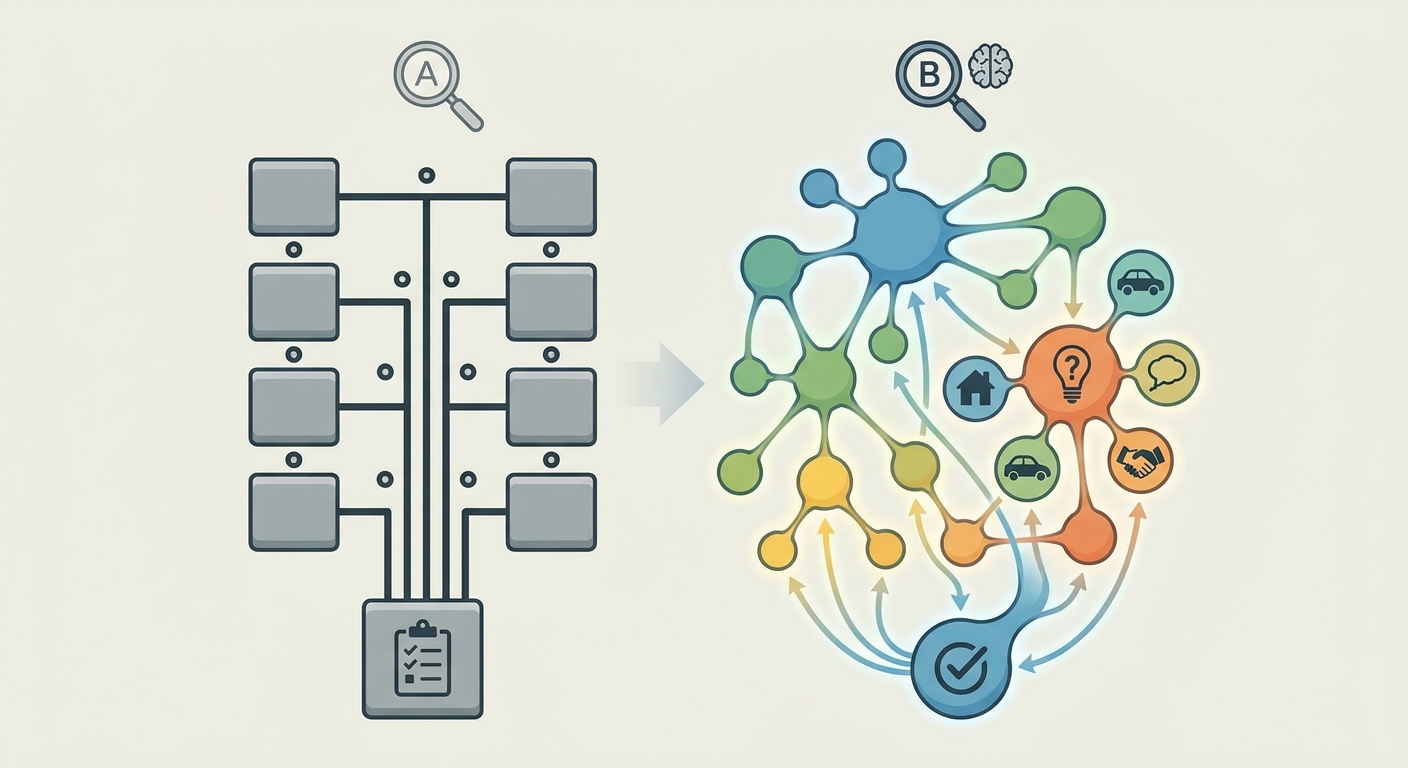
Traditional search engines operate on a straightforward principle: match the words in a query to the words in a document. It works well enough when users know exactly what to type. The problem is that most people don’t search that way. They ask questions in natural language, use synonyms, make spelling mistakes, or leave out words they assume are obvious from context.
AI Search solves this by understanding the intent behind a query. A user searching for “affordable options for tracking team hours” and one searching for “cheap employee time tracking software” are asking the same question. Traditional search may treat these as entirely different queries. An AI-powered search engine recognises they’re the same and returns relevant results for both.
The core technologies behind AI Search include:
- Natural Language Processing (NLP): Allows the system to understand human language as it’s actually written or spoken, including grammar, context, and nuance.
- Machine Learning: Enables the search engine to improve over time by learning from user behaviour — which results get clicked, how long users engage, and what they search next.
- Semantic Search: Focuses on the meaning of words in context rather than the words themselves, so the system can connect related concepts even when different terminology is used.
- Vector Embeddings: A mathematical way of representing words and phrases so that similar meanings are positioned close together, enabling smarter relevance ranking.
AI Search vs. Traditional Search vs. Semantic Search
These three approaches are often conflated, but they’re meaningfully different. Here’s how they compare across the dimensions that matter most to a business evaluating its options.
| Feature | Traditional Search | Semantic Search | AI Search |
|---|---|---|---|
| Query understanding | Exact keyword matching | Meaning and context | Intent, context, and personalisation |
| Handles natural language | Limited | Moderate | Strong |
| Learns from user behaviour | No | Partially | Yes, continuously |
| Personalisation | None | Minimal | High |
| Handles typos and synonyms | Poorly | Moderately | Well |
| Setup complexity | Low | Moderate | Moderate to high |
| Cost | Low | Moderate | Higher, but scalable |
| Best suited for | Simple, structured content | Knowledge bases, documentation | E-commerce, enterprise, customer-facing search |
The takeaway for most businesses: traditional search is fast and cheap but frustrating for users. Semantic search is a meaningful step forward. AI Search combines semantic understanding with real-time learning and personalisation, making it the most capable option for businesses with complex content or high search volumes.
The Business Benefits of AI-Powered Search

The reason businesses invest in AI Search isn’t because it’s technically impressive — it’s because it moves real commercial metrics.
Higher conversion rates. When customers find what they’re looking for faster, they buy. Retailers that implement AI-powered on-site search consistently report meaningful lifts in conversion. Users who engage with search are already high-intent; the question is whether the results earn their trust.
Fewer zero-result pages. Zero-result searches are a quiet killer of revenue. A customer who searches for a product using slightly different terminology than your catalogue uses and gets no results will often leave rather than try again. AI Search bridges that vocabulary gap automatically.
Better internal knowledge retrieval. For enterprises, the value isn’t just customer-facing. Teams searching internal documentation, HR policies, product specs, or compliance materials benefit enormously from AI Search. Instead of browsing folder structures or relying on exact document titles, employees can ask plain-language questions and get precise answers.
Personalised experiences at scale. AI Search can factor in a user’s history, role, location, and browsing behaviour to rank results that are most relevant to that specific person — not just the average user. This kind of personalisation was previously only possible with significant engineering investment.
Real-World Applications Across Industries
AI Search isn’t a single product — it takes different forms depending on where it’s deployed.
- E-commerce: Retailers use AI Search to handle complex product catalogues, understand intent-heavy queries like “comfortable running shoes for wide feet,” and surface relevant products even when inventory descriptions don’t exactly match customer language. Businesses in this space that have moved from basic keyword search to AI-powered alternatives have reported reductions in zero-result rates of [insert client metric here] and measurable increases in average order value.
- Healthcare: Hospitals and health information platforms use AI Search to help patients find clinically accurate information without needing to know medical terminology. The same technology helps clinical staff retrieve relevant research or patient records quickly.
- Financial Services: Banks and insurance providers use AI Search in their knowledge bases and customer portals to surface the right policy documents, regulatory guidance, or account information based on conversational queries.
- SaaS and Technology: Software companies use AI Search within their products to help users find features, documentation, and support articles — reducing support ticket volume and improving user onboarding.
Challenges in AI Search Adoption — and How to Overcome Them
Adopting AI Search isn’t without friction. Understanding the common sticking points early means you can plan around them rather than discover them after launch.
Data quality. AI Search learns from your content. If your product descriptions are inconsistent, your documentation is outdated, or your metadata is sparse, the system has less to work with. The fix isn’t to delay implementation — it’s to audit your content before you begin and treat content quality as an ongoing discipline.
Integration complexity. Connecting an AI Search platform to existing databases, CRM systems, or content management tools can require engineering resource. Most modern platforms offer API-based integration and pre-built connectors for common systems, but you should map your tech stack carefully before choosing a solution.
Algorithmic bias. AI systems learn from historical data, which means they can inherit the biases present in that data. If certain products, content types, or user groups have historically received less engagement — for reasons unrelated to quality — an AI system trained on that history may perpetuate the gap. Building in regular audits of search result fairness is worth doing, particularly for businesses serving diverse audiences.
Cost. Enterprise AI Search platforms typically operate on usage-based or tiered subscription pricing. Costs vary significantly depending on query volume, the number of indexed documents, and the level of customisation required. Smaller businesses should look at mid-market solutions — many providers offer plans designed for organisations that process fewer than [X] searches per month — rather than assuming AI Search is only accessible to large enterprises.
User adoption. A search experience can be technically excellent and still fail if users don’t trust it. Rolling out AI Search with clear communication about what’s changed, why it’s better, and how users can give feedback makes a real difference to how quickly adoption takes hold.
Implementing AI Search: A Practical Starting Point for SMBs
If you’re a small or medium-sized business considering AI Search for the first time, the process doesn’t have to be overwhelming. A reasonable starting framework looks like this:
- Identify your biggest search friction point. Is it on-site product search? Internal knowledge retrieval? Customer support deflection? Start with the area where poor search is costing you the most — in revenue, in support time, or in user frustration.
- Audit your existing content. AI Search works best when the underlying content is accurate, consistently structured, and reasonably well-labelled. A content audit before implementation saves significant time later.
- Evaluate platforms against your actual query volume. Many providers offer free tiers or trials. Run a realistic sample of your actual search queries through candidate platforms and compare the quality of results before committing.
- Plan for measurement from day one. Define what success looks like before you launch — whether that’s a reduction in zero-result searches, an increase in click-through rates, or a drop in support tickets. Without baseline metrics, it’s difficult to demonstrate value.
- Iterate based on real data. The advantage of AI Search is that it improves with use. Set a regular review cadence — monthly in the first six months is reasonable — to assess performance and refine your configuration.