

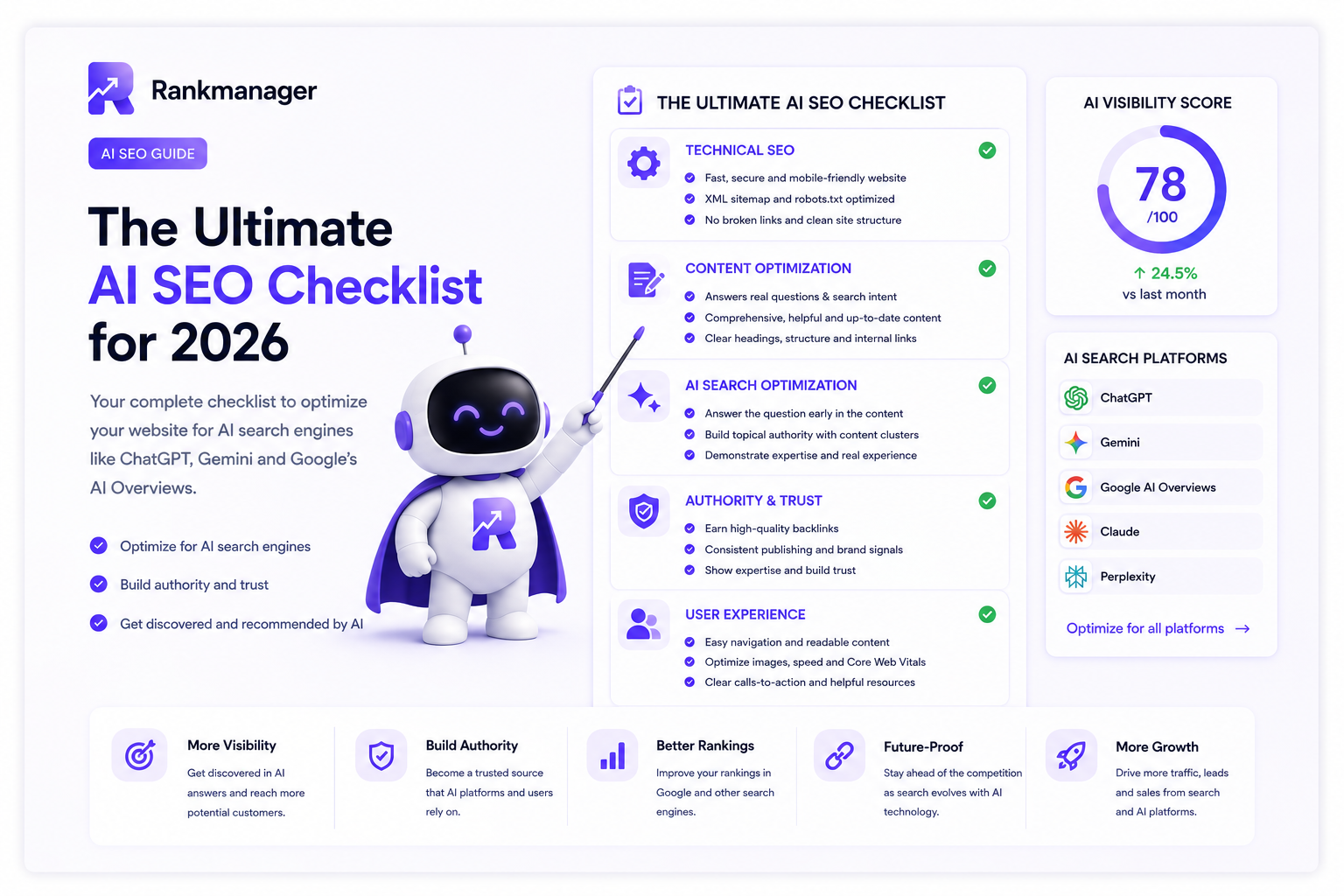
The Ultimate AI SEO Checklist for 2026: Everything You Need to Optimize Your Website
The Ultimate AI SEO Checklist for 2026
Introduction
Search is evolving faster than ever.
Ranking well in Google is still important, but it’s no longer the only goal. AI-powered platforms like ChatGPT, Google AI Overviews, Gemini, Claude, and Perplexity are changing how people discover businesses online.
Instead of browsing multiple websites, users increasingly receive a single AI-generated answer.
So how do you ensure your website is one of the sources AI trusts?
This checklist covers everything you need to optimize your website for both traditional search engines and AI-powered search in 2026.
Bookmark this page and use it as your ongoing optimization guide.
Foundation: Technical SEO
Before AI can recommend your website, it must be able to crawl, understand and trust it.
✅ Website loads in under 2 seconds
Fast websites improve both user experience and search visibility.
Check:
- Core Web Vitals
- Largest Contentful Paint (LCP)
- Interaction to Next Paint (INP)
- Cumulative Layout Shift (CLS)
✅ Mobile-friendly website
More than half of all searches happen on mobile devices.
Make sure:
- Text is readable
- Buttons are easy to tap
- Navigation works smoothly
- Images scale correctly
✅ HTTPS enabled
Your website should always use SSL.
A secure website is a basic trust signal.
✅ XML Sitemap available
Ensure search engines can easily discover all important pages.
Submit your sitemap to Google Search Console.
✅ Robots.txt configured correctly
Double-check that you’re not accidentally blocking important pages from being crawled.
✅ Clean URL structure
Good URLs should be:
- Short
- Descriptive
- Easy to read
Example:
/ai-search-guide
instead of
/page?id=4829
✅ No broken links
Broken internal and external links create a poor user experience.
Regularly scan your website and fix them.
Content Optimization
Content remains the most important ranking factor.
✅ Answer a real question
Every page should solve a specific problem.
Ask yourself:
“Would this article genuinely help someone?”
✅ Strong H1 title
Use one H1 that clearly explains the topic.
Example:
The Ultimate AI SEO Checklist for 2026
✅ Logical heading structure
Organize your content using:
- H2 sections
- H3 subsections
- Bullet lists
- Numbered steps
Well-structured content is easier for both humans and AI.
✅ Comprehensive content
Cover your topic completely.
Include:
- Definitions
- Examples
- Best practices
- Common mistakes
- FAQs
Don’t create shallow articles.
✅ Write naturally
Avoid writing for algorithms.
Instead:
Write exactly as you would explain the topic to a customer.
✅ Keep content updated
Review important articles every three to six months.
Update:
- Statistics
- Examples
- Screenshots
- Best practices
Fresh content builds trust.
AI Search Optimization
These optimizations help AI platforms understand and recommend your content.
✅ Answer the primary question immediately
Place a concise answer near the beginning of every article.
Expand into detail afterward.
✅ Build topic clusters
Instead of isolated articles, create connected knowledge hubs.
Example:
AI Search
- What Is AI Search?
- SEO vs GEO
- AI Search Checklist
- AI Visibility
- ChatGPT Rankings
Topic clusters strengthen authority.
✅ Demonstrate expertise
Include:
- Original insights
- Practical examples
- Research
- Case studies
- First-hand experience
AI rewards expertise.
✅ Focus on helpfulness
Ask yourself:
“Is this the best answer available?”
If not, improve it.
✅ Create unique content
Avoid publishing articles that simply repeat what already exists.
Offer:
- New perspectives
- Better explanations
- More practical advice
Internal Linking
Internal links remain one of the easiest SEO wins.
✅ Every article links to related content
Example:
An AI Search article should naturally link to:
- SEO vs GEO
- AI Visibility
- Technical SEO
- WordPress SEO
- AI Content
✅ Link back to cornerstone pages
Every topic cluster should have one central article.
Example:
What Is AI Search?
All related blogs should link back to this cornerstone page.
✅ Use descriptive anchor text
Instead of:
“Click here”
Use:
“Learn more about AI Search.”
Authority & Trust
AI increasingly values trustworthy websites.
✅ Publish consistently
Consistency builds authority.
Aim for at least:
- One quality article every week
or - Four to eight articles each month
✅ Showcase expertise
Include:
- Author information
- Company expertise
- Real experience
Trust matters.
✅ Earn backlinks
High-quality backlinks remain valuable.
Focus on earning links naturally through valuable content.
✅ Build your brand
Strong brands are more likely to be recommended by AI.
Maintain consistent branding across:
- Website
- Social media
- Blog
- Newsletters
Technical Enhancements
✅ Add Schema Markup
Use structured data whenever appropriate.
Helpful schema types include:
- Article
- FAQ
- Organization
- Breadcrumb
- Product
- Review
✅ Optimize images
Every image should have:
- Descriptive filename
- Alt text
- Compression
- Modern formats like WebP
✅ Compress JavaScript and CSS
Smaller files improve page speed.
✅ Lazy-load images
Improve loading speed by only loading images when users scroll.
✅ Monitor indexing
Regularly check Google Search Console for:
- Indexing issues
- Crawl errors
- Manual actions
User Experience
Search engines increasingly reward websites people enjoy using.
✅ Easy navigation
Visitors should find information quickly.
✅ Short paragraphs
Large blocks of text reduce readability.
✅ Use visual elements
Add:
- Screenshots
- Diagrams
- Tables
- Infographics
Visual content improves engagement.
✅ Include FAQs
Frequently Asked Questions often match the conversational way people interact with AI.
✅ Strong call-to-action
Every important article should guide readers toward the next step.
Examples:
- Start a free trial
- Read another guide
- Book a demo
Common AI SEO Mistakes
Avoid these mistakes:
❌ Publishing hundreds of low-quality AI articles
❌ Ignoring technical SEO
❌ Weak internal linking
❌ Duplicate content
❌ Never updating articles
❌ Keyword stuffing
❌ Writing for algorithms instead of people
❌ Publishing random topics without a strategy
Quick AI SEO Checklist
Use this before publishing any article.
Technical
✅ Fast website
✅ Mobile-friendly
✅ HTTPS
✅ XML sitemap
✅ Schema markup
✅ No broken links
Content
✅ Helpful
✅ Comprehensive
✅ Up-to-date
✅ Easy to read
✅ Well structured
AI Optimization
✅ Answers the main question immediately
✅ Builds topical authority
✅ Demonstrates expertise
✅ Links to related content
✅ Provides unique value
Authority
✅ Strong brand
✅ Consistent publishing
✅ Backlinks
✅ Internal links
User Experience
✅ Short paragraphs
✅ Visuals
✅ Clear navigation
✅ Strong CTA
How Rankmanager Helps
Keeping up with SEO and AI Search manually can be overwhelming.
Rankmanager automates many of these tasks.
With Rankmanager, you can:
- Generate AI-optimized content
- Improve existing pages
- Build topic clusters
- Automate internal linking
- Monitor technical SEO
- Discover content opportunities
- Track AI visibility
- Stay ahead of algorithm changes
Instead of managing dozens of SEO tasks manually, Rankmanager helps you continuously optimize your website for both Google and AI-powered search.
Frequently Asked Questions
What is AI SEO?
AI SEO combines traditional SEO with optimization techniques that help AI-powered search platforms understand and recommend your content.
Is this checklist only for AI Search?
No. Almost every item also improves traditional Google rankings, making this a future-proof optimization checklist.
How often should I review this checklist?
Review it whenever you publish new content and perform a full website audit every quarter.
Do small businesses need AI SEO?
Absolutely. AI Search is becoming mainstream, and early adopters have a significant competitive advantage.
Final Thoughts
The future of SEO isn’t about choosing between Google and AI.
It’s about optimizing for both.
The websites that succeed in 2026 will be technically excellent, publish genuinely helpful content, demonstrate real expertise, and continuously improve over time.
Use this checklist as your benchmark whenever you create or update content.
Every box you check brings your website one step closer to becoming a trusted source for both search engines and AI assistants.


Scalability for Growing Businesses
As businesses grow, their needs evolve. SaaS tools are designed to scale alongside organizations, allowing them to add users, features, and integrations without major disruptions. This flexibility ensures that companies can maintain productivity even during periods of rapid growth. There’s no need for costly infrastructure upgrades or complicated migrations—everything adapts seamlessly.
- Keep tasks, files, and communication in one place to reduce time spent switching between tools.
- Automate routine processes like data entry, notifications, and reporting to save time.
- Enable teams to work together instantly, improving communication and reducing delays.
- Access your work from anywhere, allowing flexibility and remote productivity.
- Use real-time analytics and insights to make informed and timely decisions.
SaaS tools allow employees to work from anywhere, whether in the office, at home, or on the move. This flexibility not only improves productivity but also supports better work-life balance. With mobile access and cloud synchronization, users can stay connected and productive without being tied to a specific location. Unlike traditional software, SaaS platforms are constantly evolving. Providers regularly release updates, introduce new features, and improve performance without disrupting users.
Improving productivity is not about working harder—it’s about working smarter. SaaS tools provide the foundation for modern, efficient workflows by combining automation, collaboration, accessibility, and data-driven insights.