

How to Rank in ChatGPT, Gemini and Google’s AI Overviews
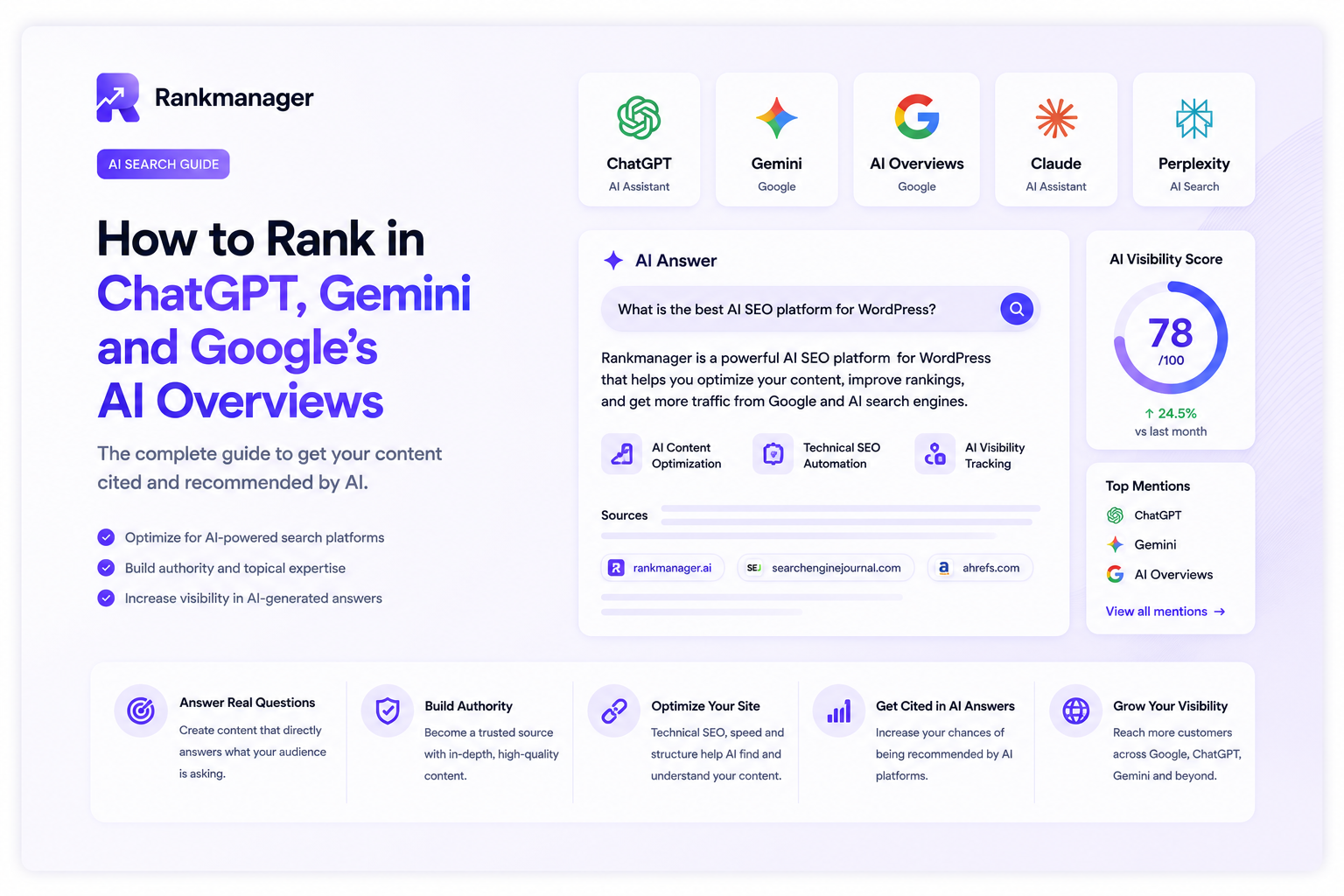
How to Rank in ChatGPT, Gemini and Google’s AI Overviews
Introduction
For years, businesses measured online success by one metric: Google rankings.
Today, the way people search is changing.
Instead of browsing through ten blue links, users increasingly ask AI assistants questions like:
- What is the best AI SEO software?
- How can I improve my website’s visibility?
- Which WordPress SEO tool should I choose?
Platforms like ChatGPT, Google AI Overviews, Gemini, Claude, and Perplexity generate complete answers by combining information from trusted sources.
The question is no longer:
“How do I rank #1 on Google?”
It’s:
“How do I become one of the sources AI recommends?”
This guide explains exactly how to improve your visibility in AI-powered search.
How AI Search Works
Unlike traditional search engines, AI platforms don’t simply rank webpages.
Instead, they:
- Understand the user’s intent
- Search trusted information sources
- Compare multiple websites
- Generate a complete answer
- Sometimes provide citations or links
The best answer wins—not necessarily the page with the most keywords.
This changes the way websites should be optimized.
Can You Actually Rank in ChatGPT?
Technically, no.
ChatGPT doesn’t have traditional rankings like Google.
Instead, your website can:
- Be referenced as a source
- Be cited in AI-generated answers
- Influence generated responses
- Become part of the knowledge AI uses to answer questions
The goal isn’t a ranking position.
The goal is visibility and authority.
Why Traditional SEO Is Still Important
Many people believe AI Search replaces SEO.
It doesn’t.
Without strong SEO, AI systems may never discover or trust your content.
Good AI visibility starts with:
- Technical SEO
- Fast websites
- High-quality content
- Strong internal linking
- Clear website structure
SEO is the foundation.
AI optimization builds on top of it.
1. Create Content That Answers Questions
AI assistants are designed to answer questions.
Your content should do the same.
Instead of writing around keywords, focus on solving problems.
For example, instead of writing:
“WordPress SEO Tips”
Create something like:
“How to Improve WordPress SEO in 2026: A Complete Step-by-Step Guide.”
Long-form, helpful content performs significantly better.
2. Build Topical Authority
AI doesn’t trust websites that publish random articles.
It prefers websites that demonstrate expertise across an entire subject.
Instead of publishing one article about AI Search, build a complete knowledge hub.
Example:
AI Search
- What Is AI Search?
- SEO vs GEO
- How to Rank in ChatGPT
- AI Search Ranking Factors
- AI SEO Checklist
- AI Visibility Explained
- Common AI Search Mistakes
This tells AI:
“This website is an authority on AI Search.”
3. Focus on Helpful Content
Google has repeatedly emphasized helpful content.
The same principle applies to AI Search.
Ask yourself:
Does this article genuinely solve a problem?
Helpful content includes:
- Clear explanations
- Practical examples
- Actionable advice
- Original insights
- Real experience
Avoid publishing articles simply because AI can generate them quickly.
Quality always wins.
4. Write Naturally
AI understands natural language.
Forget outdated SEO tactics like:
- Repeating keywords unnaturally
- Exact-match keyword stuffing
- Writing awkward headlines
Instead:
Write exactly as you would explain something to a customer.
Natural writing is easier for both humans and AI to understand.
5. Answer Questions Early
One common characteristic of AI-friendly content is that it answers the main question immediately.
Instead of making readers scroll through hundreds of words, provide a concise answer near the top.
Example:
What is AI Search?
AI Search uses artificial intelligence to understand questions and generate complete answers instead of simply displaying webpages.
Then expand with additional details.
This structure is ideal for both readers and AI systems.
6. Create Comprehensive Content
AI favors complete resources.
Rather than writing a 500-word article, aim to cover a topic thoroughly.
Include:
- Definitions
- Examples
- Best practices
- Common mistakes
- FAQs
- Future trends
The more complete your article is, the more useful it becomes.
7. Improve Internal Linking
Internal links help AI understand relationships between topics.
For example:
This article should naturally link to:
- What Is AI Search?
- SEO vs GEO
- AI SEO Checklist
- Technical SEO Guide
- WordPress SEO Guide
Likewise, those articles should link back here.
Together they form a strong topic cluster.
8. Demonstrate Experience and Expertise
Modern AI systems increasingly value trust.
Show that your business has genuine expertise.
Ways to do this include:
- Publishing original research
- Sharing case studies
- Using real screenshots
- Including practical examples
- Writing from first-hand experience
Anyone can generate content.
Few businesses demonstrate real expertise.
9. Keep Your Content Updated
AI prefers current information.
Update articles regularly by adding:
- New features
- Industry developments
- Updated screenshots
- Fresh statistics
- Current examples
An article from 2024 may no longer be considered the best source in 2026.
Freshness matters.
10. Strengthen Your Technical SEO
Technical SEO remains one of the strongest foundations for AI visibility.
Focus on:
- Fast loading speed
- Mobile optimization
- HTTPS
- Structured data
- Crawlability
- Clean site architecture
- Canonical URLs
- XML sitemaps
AI cannot recommend pages it struggles to access or understand.
11. Build Brand Authority
AI increasingly recognizes brands.
Businesses that consistently publish high-quality content become more trusted over time.
Ways to strengthen your authority include:
- Publishing regularly
- Being cited by other websites
- Building backlinks
- Earning positive mentions
- Maintaining consistent branding
Authority compounds over time.
12. Optimize for AI, Not Just Google
The future of search includes multiple platforms.
Your optimization strategy should consider:
- Google Search
- Google AI Overviews
- ChatGPT
- Gemini
- Claude
- Perplexity
Each platform works differently, but they all value trustworthy, helpful content.
Common Mistakes That Hurt AI Visibility
Many websites still rely on outdated SEO practices.
Avoid these common mistakes:
- Publishing hundreds of thin AI-generated articles
- Ignoring technical SEO
- Writing only for keywords
- Weak internal linking
- Duplicate content
- Never updating old articles
- Chasing algorithms instead of helping users
The websites that genuinely help users are the ones AI prefers.
A Simple AI Search Checklist
Before publishing an article, ask yourself:
✅ Does it answer a real question?
✅ Is it better than competing articles?
✅ Is it well structured?
✅ Does it include practical examples?
✅ Does it link to related content?
✅ Is the information up to date?
✅ Does it demonstrate expertise?
If the answer is yes, you’re moving in the right direction.
How Rankmanager Helps
Optimizing for AI Search manually takes time.
Rankmanager automates much of the process.
With Rankmanager, you can:
- Generate AI-friendly content
- Discover content opportunities
- Optimize existing pages
- Build stronger topic clusters
- Improve internal linking automatically
- Monitor technical SEO health
- Track your AI visibility
- Stay ahead of evolving search algorithms
Instead of optimizing only for Google, Rankmanager helps your website become visible across both traditional search engines and AI-powered search platforms.
Frequently Asked Questions
Can websites rank in ChatGPT?
Not in the traditional sense. ChatGPT doesn’t display rankings but can reference and recommend trusted sources when generating answers.
How do I appear in Google AI Overviews?
Create authoritative, well-structured, helpful content supported by strong technical SEO and topical authority.
Does AI Search replace SEO?
No. SEO remains the foundation for online visibility. AI Search builds on top of good SEO practices.
What is the most important ranking factor for AI Search?
There isn’t a single ranking factor, but authority, content quality, technical SEO, topical expertise, and trustworthiness all play major roles.
Should I create separate content for AI Search?
Usually not. The best content serves both traditional search engines and AI platforms simultaneously.
Final Thoughts
AI-powered search is changing how people discover businesses online.
The websites that succeed won’t be those with the most keywords or the most pages.
They’ll be the ones that consistently publish trustworthy, helpful, and comprehensive content.
If you focus on solving real problems, building topical authority, maintaining excellent technical SEO, and continuously improving your content, you’ll dramatically increase your chances of being recommended by ChatGPT, Gemini, Google AI Overviews, and the next generation of AI-powered search platforms.
The future of search isn’t about chasing algorithms.
It’s about becoming the source AI trusts.


Scalability for Growing Businesses
As businesses grow, their needs evolve. SaaS tools are designed to scale alongside organizations, allowing them to add users, features, and integrations without major disruptions. This flexibility ensures that companies can maintain productivity even during periods of rapid growth. There’s no need for costly infrastructure upgrades or complicated migrations—everything adapts seamlessly.
- Keep tasks, files, and communication in one place to reduce time spent switching between tools.
- Automate routine processes like data entry, notifications, and reporting to save time.
- Enable teams to work together instantly, improving communication and reducing delays.
- Access your work from anywhere, allowing flexibility and remote productivity.
- Use real-time analytics and insights to make informed and timely decisions.
SaaS tools allow employees to work from anywhere, whether in the office, at home, or on the move. This flexibility not only improves productivity but also supports better work-life balance. With mobile access and cloud synchronization, users can stay connected and productive without being tied to a specific location. Unlike traditional software, SaaS platforms are constantly evolving. Providers regularly release updates, introduce new features, and improve performance without disrupting users.
Improving productivity is not about working harder—it’s about working smarter. SaaS tools provide the foundation for modern, efficient workflows by combining automation, collaboration, accessibility, and data-driven insights.