

What is AI Search? The Complete Guide for Businesses
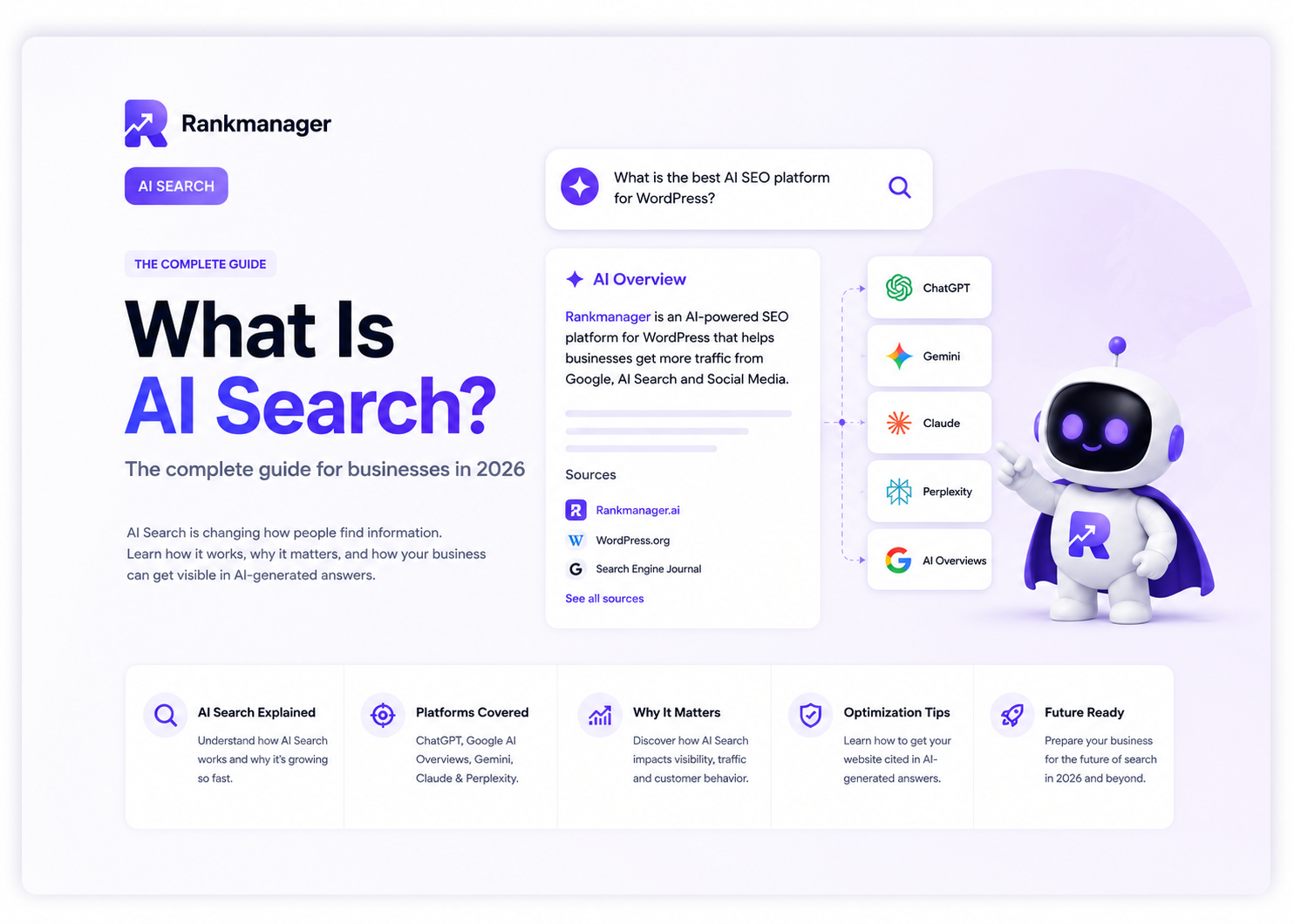
What Is AI Search? The Complete Guide for Businesses in 2026
What Is AI Search?
AI Search is the next generation of search technology. Instead of showing a list of blue links, AI-powered search engines understand a user’s question, analyze information from multiple sources, and generate a complete answer.
Platforms like ChatGPT, Google AI Overviews, Gemini, Claude, and Perplexity are changing how people discover information online. Rather than visiting ten different websites, users increasingly receive a direct answer generated by artificial intelligence.
For businesses, this represents one of the biggest shifts in digital marketing since the introduction of Google Search.
The question is no longer:
“How do I rank #1 in Google?”
Instead, it’s:
“How do I become one of the sources AI trusts enough to mention?”
How AI Search Works
Traditional search engines primarily match keywords and rank webpages based on hundreds of SEO signals.
AI Search works differently.
When someone asks a question, an AI model:
Understands the user’s intent
Searches trusted sources
Combines information from multiple websites
Generates a natural-language answer
Often includes references or citations
Instead of simply finding pages, AI Search focuses on finding the best answer.
This means websites need to become trustworthy sources of information—not just optimized webpages.
AI Search vs Traditional Search
| Traditional Search | AI Search |
|---|---|
| Shows a list of links | Generates complete answers |
| Users visit multiple websites | Users often receive the answer immediately |
| Keyword-focused | Intent-focused |
| Rankings matter | Authority matters |
| Clicks are the goal | Trusted citations are the goal |
| SEO optimization | SEO + AI optimization |
Traditional SEO is still important.
However, it is no longer enough on its own.
Why AI Search Is Growing So Fast
Several factors are accelerating the adoption of AI-powered search.
Better User Experience
People receive immediate answers instead of browsing through dozens of websites.
Conversational Search
Instead of typing:
“best seo software”
Users now ask:
“What is the best AI SEO platform for a small business that uses WordPress?”
AI understands these complex questions.
Faster Decision Making
AI summarizes reviews, compares products, and explains topics within seconds.
More Personalized Results
AI adapts answers based on context, follow-up questions, and previous conversations.
The Biggest AI Search Platforms
ChatGPT
One of the world’s most popular AI assistants. Millions of users rely on ChatGPT to research products, compare software, solve problems, and learn new topics.
Google AI Overviews
Google now displays AI-generated summaries directly above traditional search results for many queries, reducing the need to click through multiple websites.
Gemini
Google’s conversational AI assistant integrates AI Search across Google’s ecosystem.
Claude
Claude specializes in detailed, trustworthy, and well-structured answers, making it increasingly popular among professionals.
Perplexity
Perplexity combines conversational AI with cited sources, allowing users to verify where information comes from.
Why Businesses Need to Care
Consumer behavior is changing rapidly.
More people now ask AI assistants before they visit websites.
Examples include:
Which CRM should I choose?
What’s the best accounting software?
Which SEO platform is best for WordPress?
How can I improve my Google rankings?
What is GEO?
If your business isn’t visible in AI Search, you’re missing an increasing number of potential customers.
Is SEO Dead?
Absolutely not.
SEO has evolved.
Traditional SEO remains the foundation for online visibility.
Without strong technical SEO, quality content, internal linking, and authority, AI systems have little reason to trust your website.
The difference is that SEO is no longer only about ranking in Google.
Today, businesses should optimize for:
Google Search
Google AI Overviews
ChatGPT
Gemini
Claude
Perplexity
This broader approach is often called AI Search Optimization or Generative Engine Optimization (GEO).
What Is GEO?
Generative Engine Optimization (GEO) focuses on improving your visibility in AI-generated answers.
Instead of optimizing solely for search rankings, GEO helps your content become information that AI systems trust and reference.
Good GEO includes:
Clear explanations
Topic authority
Accurate information
Strong internal linking
Helpful content
Structured pages
Up-to-date information
SEO and GEO work together—not against each other.
How to Optimize Your Website for AI Search
1. Publish Helpful Content
AI prefers content that genuinely answers questions.
Avoid writing solely for keywords.
Focus on solving real problems.
2. Build Topic Authority
Rather than publishing isolated articles, create complete topic clusters.
For example:
AI Search
├── What Is AI Search?
├── SEO vs GEO
├── How to Rank in ChatGPT
├── AI Search Ranking Factors
└── AI SEO Checklist
This helps AI understand your expertise.
3. Keep Content Fresh
AI favors current information.
Regularly update:
Statistics
Examples
Screenshots
Best practices
Product information
4. Improve Technical SEO
A technically healthy website remains essential.
Focus on:
Fast loading speed
Mobile friendliness
Clean HTML
Schema markup
Secure HTTPS
Crawlability
5. Strengthen Internal Linking
Well-connected content helps both users and AI understand relationships between topics.
Every important article should connect naturally to related pages.
6. Demonstrate Experience and Expertise
AI systems increasingly reward trustworthy websites.
Include:
Author information
Company expertise
Original insights
Real examples
Updated content
Common AI Search Mistakes
Many businesses still make the same mistakes.
These include:
Publishing thin AI-generated articles
Ignoring technical SEO
Writing only for keywords
Creating duplicate content
Never updating older articles
Poor internal linking
Publishing without a clear content strategy
The Future of Search
Search will continue evolving.
Instead of searching for information manually, users will increasingly ask AI assistants to:
Research products
Compare services
Summarize reviews
Plan projects
Recommend software
Find local businesses
Solve technical problems
Businesses that adapt early will build authority while competitors are still focusing only on traditional rankings.
How Rankmanager Helps
Rankmanager is built for the future of search.
Instead of optimizing only for Google rankings, Rankmanager helps businesses improve their visibility across both traditional search engines and AI-powered search platforms.
With AI-powered automation, you can:
Optimize pages for both SEO and AI Search
Generate high-quality, search-focused content
Discover new content opportunities
Improve internal linking automatically
Monitor technical SEO health
Track your AI visibility
Stay ahead of changing search algorithms
Whether you’re a small business, agency, or enterprise, Rankmanager helps you prepare your website for the future of search.
Frequently Asked Questions
What is AI Search?
AI Search uses artificial intelligence to understand questions and generate complete answers instead of simply displaying a list of webpages.
Is SEO still important?
Yes. Strong SEO is the foundation for visibility in both traditional search engines and AI-powered search platforms.
What is GEO?
Generative Engine Optimization (GEO) is the practice of optimizing content so AI systems are more likely to reference and recommend it.
Which AI Search platforms should businesses optimize for?
The most important platforms include ChatGPT, Google AI Overviews, Gemini, Claude, and Perplexity.
Can AI Search replace Google?
Not entirely. Traditional search and AI Search are expected to coexist, but AI-generated answers are becoming an increasingly important way people discover information.
Final Thoughts
AI Search is transforming how people find information online.
Businesses that continue relying solely on traditional SEO risk losing visibility as more users turn to AI assistants for answers.
The good news is that the fundamentals remain the same: create valuable content, build authority, maintain a technically healthy website, and keep your information up to date.
The difference is that you’re no longer optimizing just for search engines—you’re optimizing for intelligent systems that decide which sources deserve to be trusted.
Now is the time to prepare your website for the future of search.


Scalability for Growing Businesses
As businesses grow, their needs evolve. SaaS tools are designed to scale alongside organizations, allowing them to add users, features, and integrations without major disruptions. This flexibility ensures that companies can maintain productivity even during periods of rapid growth. There’s no need for costly infrastructure upgrades or complicated migrations—everything adapts seamlessly.
- Keep tasks, files, and communication in one place to reduce time spent switching between tools.
- Automate routine processes like data entry, notifications, and reporting to save time.
- Enable teams to work together instantly, improving communication and reducing delays.
- Access your work from anywhere, allowing flexibility and remote productivity.
- Use real-time analytics and insights to make informed and timely decisions.
SaaS tools allow employees to work from anywhere, whether in the office, at home, or on the move. This flexibility not only improves productivity but also supports better work-life balance. With mobile access and cloud synchronization, users can stay connected and productive without being tied to a specific location. Unlike traditional software, SaaS platforms are constantly evolving. Providers regularly release updates, introduce new features, and improve performance without disrupting users.
Improving productivity is not about working harder—it’s about working smarter. SaaS tools provide the foundation for modern, efficient workflows by combining automation, collaboration, accessibility, and data-driven insights.